Biodiversity Bird Blends Translation Series Vol. 2
We have selected two posts from Biodiversity Bird Blends to translate and share in multiple languages. We also plan to introduce more of their posts over time!
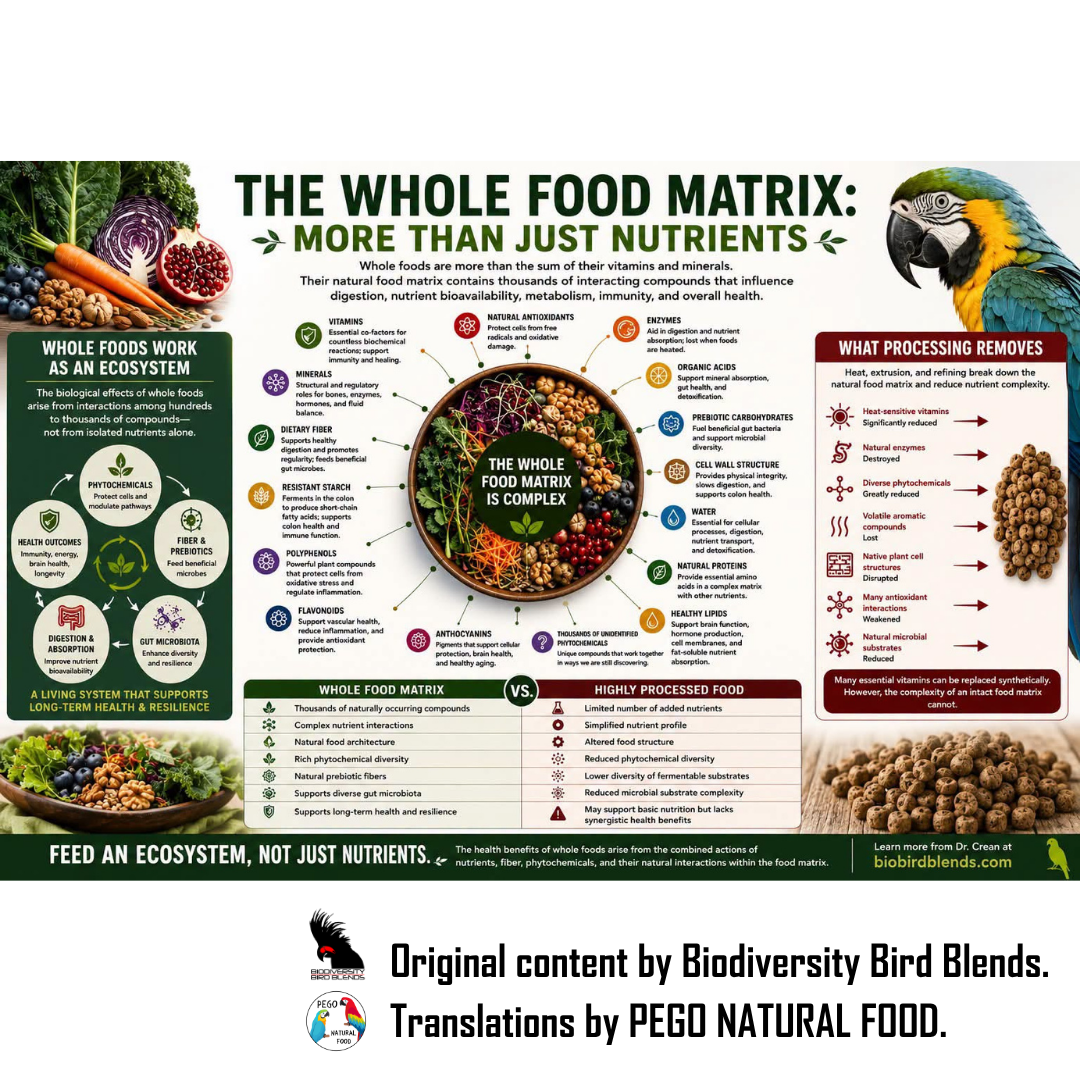
The first post explains why pellets, supplements, and similar products cannot recreate the complex food matrix found in fresh, whole foods. Whole foods not only provide a diverse range of nutrients and other compounds, but also give parrots opportunities to engage in natural foraging behaviors, such as tearing, pecking, peeling, crushing, and searching for food.
It also emphasizes that even parrots that do not immediately accept fresh foods can learn to eat them through repeated exposure and by changing the way the foods are offered. Below, we present translations of this post in several languages. You can view the original post here.
🌿🦜 IT’S FORAGING FRIDAY! AND HERE IS SOME HARD TRUTHS ABOUT BIRD NUTRITION:
🥕 There are no shortcuts to feeding fresh, whole foods. THERE IS NO PELLET, SUPPLEMENT, GEL, OR ANY OTHER CONCOCTION THAT CAN REPLACE REAL FOOD.
We’re always looking for ways to make life easier—and that’s understandable. But when it comes to feeding our birds, there simply isn’t a powder, pellet, supplement, or processed product that can fully replace the complexity of fresh, whole foods.
🥦 A piece of broccoli is more than its vitamins.
🫐 A blueberry is more than its antioxidants.
🌱 A sprout is more than its protein.
🌶️ A pepper is more than its carotenoids.
Whole foods provide a complex food matrix of nutrients, fiber, water, phytochemicals, and countless other compounds packaged together by the plant itself.
And fresh foods offer something else that a uniform processed diet simply can’t replicate: FORAGING OPPORTUNITIES.
🍃 Tearing leafy greens
🌱 Picking through sprouts
🥕 Shredding vegetables
🫛 Opening pods
🌽 Removing kernels
🫐 Crushing berries
🌺 Exploring edible flowers
Eating is supposed to be an activity, not just nutrient delivery.
“But my bird won’t eat fresh foods.”
I hear this ALL the time.
Here’s the important part:
🦜 ANY BIRD can learn to eat fresh, whole foods.
It may not happen tomorrow.
It may not happen next week. And some birds may take months of consistent exposure. That’s okay.
Don’t offer broccoli twice and decide your bird “doesn’t like broccoli.” Birds learn what food is through repeated exposure, exploration, social learning, and experience.
Change how you offer it.
🥕 Chop it.
🌿 Hang it.
🫐 Skewer it.
🥬 Weave it through cage bars.
🌱 Sprout it.
🌺 Mix colors, textures, shapes, and sizes.
🦜 Eat healthy foods in front of them.
And then keep offering them.
Persistence matters.
We spend enormous amounts of time finding the right cage, toys, perches, supplements, and enrichment for our birds. Their food deserves that same commitment.
🌿 Fresh, diverse, whole foods aren’t the shortcut. They’re the work—and our birds are worth the effort.
Feed variety.
Encourage exploration.
Create opportunities to forage.
And never give up because your bird said “no” the first 20 times.
Sometimes “I don’t eat that” simply means “I haven’t learned to eat that yet.”
🌿🦜 Happy Foraging Friday from Biodiversity Bird Blends!
◆---◆---◆---◆---◆
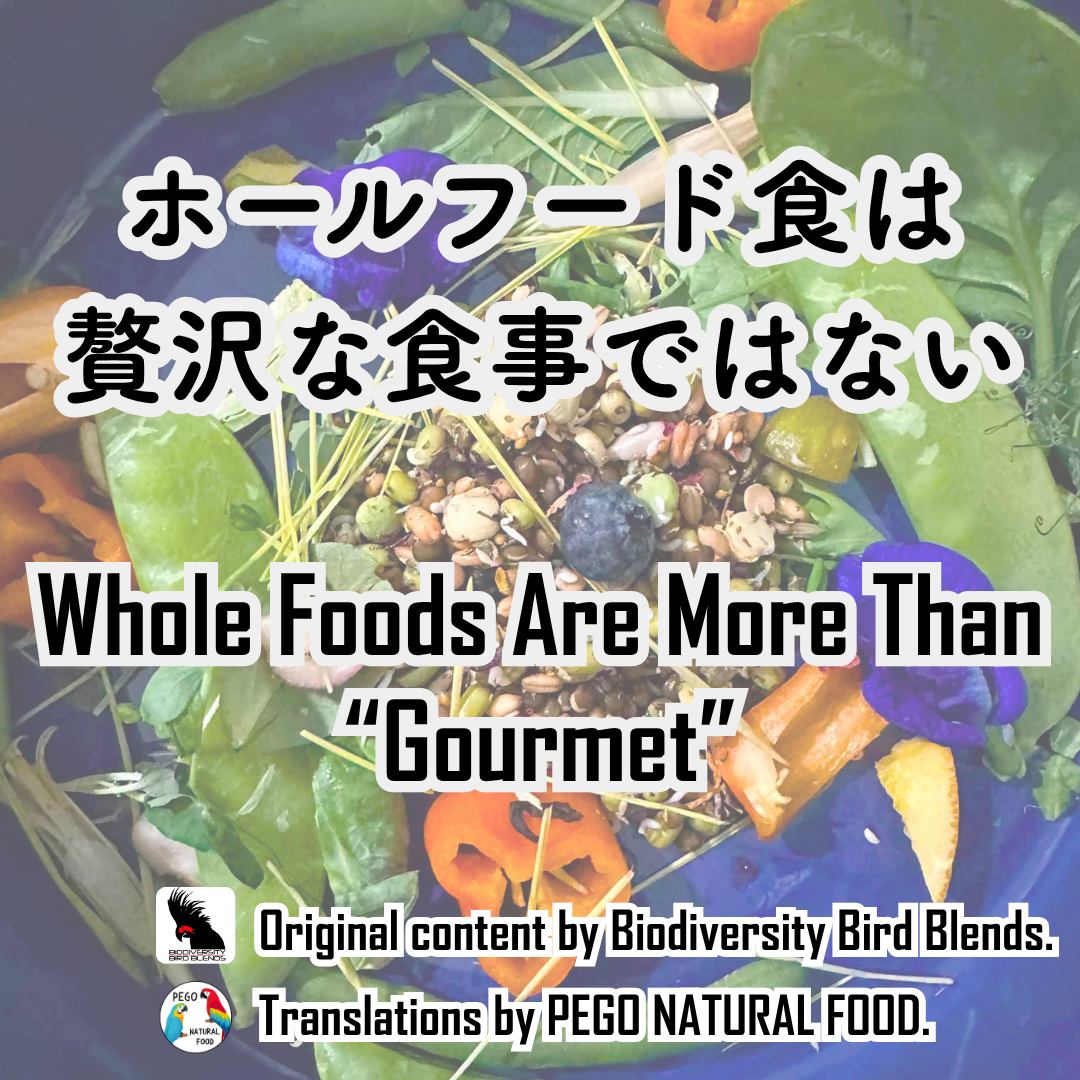
The second post suggests that feeding birds a diverse range of whole foods should not be viewed as “gourmet” or luxurious, but as a necessary part of supporting their health, longevity, and natural behaviors.
Our goal in caring for birds should not be simply to help them live longer. In addition to meeting their nutritional needs, it is important to fulfill their mental needs and provide opportunities for natural foraging behaviors, such as searching for, choosing, and eating a variety of foods. This helps birds live healthy lives both physically and mentally.
Can we determine whether a diet is truly suitable based only on experiences such as “I’ve had good results,” “My bird has always eaten this,” or “We’ve never had any problems”? This post offers an opportunity to reconsider how we should measure “success” for birds and what a truly healthy diet means. Below, we present translations of this post in several languages. You can view the original post here.

If you think this is “gourmet” food for birds, you might want to rethink your approach to avian nutrition.
I’m was invited to speak at another avicultural event on the “evolution of avian nutrition” which has me looking back and forward a great deal. Much of what has developed of the years has been an attempt at convenience… but there is nothing convenient about the keeping of the many different species we keep.
To truly know birds is to know that they require a diversity of food items that each have their own nutrient matrix, which can include hundreds of different bioactive compounds… many of which are lost during the processing of extruded pellets. Because of this significant loss, synthetic vitamins and other compounds are added to those foods in an effort to make them complete. But they aren’t.
Whole food items are critical to avian health and longevity. They can survive on ultraprocessed foods for a time, and some longer than others, but survival in our care shouldn’t be enough. Thriving should be a constant goal and satisfying not only physiological needs, but also mental/behavioral needs should be just as important.
I see many attempt to validate reductionist diets by saying “I’ve had good results” or “my bird always has eaten this” but how should we be measuring success? Birds are complex organisms that should be treated as birds, and that means treating them as organisms that have evolved to consume diverse items through a variety of foraging behaviors for most of every day.
At the Avian Nutrition Summit we hosted this past weekend, we heard from professionals who care for a wide diversity of species and all agree on a central point: You cannot beat, by any measure, real, living whole food. Visit the link in our bio for more info.
◆---◆---◆---◆---◆
That’s all for this post.
We translate and share valuable information like this in multiple languages to help parrot owners who may find English-language resources difficult to access, as well as those seeking parrot care information from the United States.
Many of the Biodiversity Bird Blends products we carry have had their ingredient formulations specially adjusted to meet import requirements in various Asian countries. We offer international shipping to destinations across Asia and many other parts of the world. If you have any questions about our products or international shipping, please feel free to contact us.
You can view our selection of Biodiversity Bird Blends products on this page.