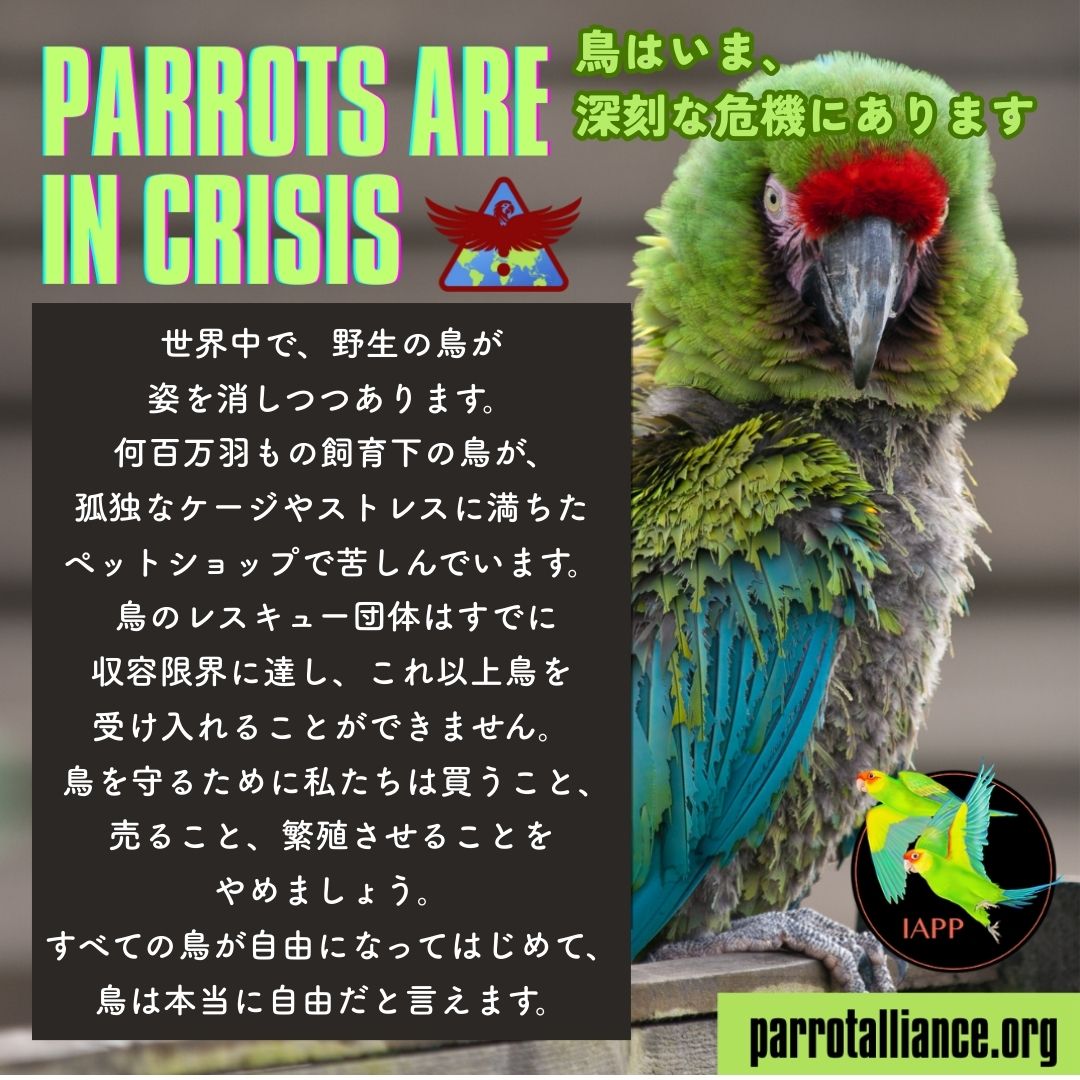
The International Alliance for the Protection of Parrots holds #ParrotCrisis Awareness Day every year on March 10.
This day is dedicated to raising awareness of the ongoing global parrot pet trade and the severe harm it causes to both wild parrots and parrots kept in captivity.
Despite the existence of international anti-poaching laws, parrots continue to be trafficked on a daily basis, and many of the birds that are captured do not survive.
At the same time, parrots bred in captivity are often abandoned when they cannot adapt to human lifestyles, leaving rescue organizations around the world overwhelmed and operating at full capacity.
To stop this crisis, we are being called to make clear choices: do not buy, breed, or sell parrots; support conservation efforts and rescue organizations; and work toward broader societal awareness and change. This article provides a detailed Japanese translation of those messages.
Except for the final section, the text below is a Japanese translation of content from the official website.
We encourage you to visit the official site as well, where additional resources and materials are available free of charge.
Who We Are
The International Alliance for the Protection of Parrots (IAPP) represents an international group of avian rescues, sanctuaries, conservation organizations, veterinarians, parrot guardians and activists who believe the time has come to address the existential crises facing both wild and captive parrots around the world.
About Parrots in Captivity
Captive parrots are one of the most frequently abandoned of all companion animals. A parrot's wild nature and natural inclination for loud and frequent vocalizations, aggression, flying, mating, and destruction of property are too much for most guardians. Most often it is not so much a parrot's failure as a pet as it is a human's failure as a guardian. A human's decision to bring a parrot into a home environment without understanding or being able to meet the fundamental needs of this flighted, wild animal precipitates the failure of a parrot to thrive as a pet.
Further complicating factors include standard pet industry practices, such as hand-rearing (i.e., parental deprivation), that actually undermine a parrot's ability to mature into a psychologically healthy, well-adjusted adult bird, and increases the likelihood of a bird's failure as a "pet". Even the most well-meaning, loving parrot guardians often find themselves unable to care for their longtime pets in the event of declining health, financial struggle, stress, or other life circumstances.
All of this, coupled with parrots' long life spans (between 20-80 years) and the estimated 3-5 million baby birds bred in the U.S. each year, has created a true crisis of unwanted parrots with nowhere to go. Sanctuaries across the globe are at capacity, unable to address the daily requests for surrender.
About Parrots in the Wild
Parrots are one of the most threatened animals in the world largely due to the pet trade and habitat loss. 29% of all parrot species are endangered or threatened and another 58% are in decline. In many areas, the poaching rate is 100% - no chicks escape the illegal wildlife trade. 90% of trapped birds die after capture, with survivors being torn from their families and usually doomed to a life of clipped or broken wings, inadequate caging, poor nutrition, and social isolation.
This results in a tremendous loss of life and suffering beyond measure, while also rendering some human communities bereft of opportunity, safety, and health. People who live near wild parrots are often marginalized and live in poverty, resorting to climbing trees to trap parrots at the risk of injury or death for income. While international treaties and laws exist to prevent the trafficking of parrots, smugglers and traffickers find ways to circumvent these laws. It is estimated that for every bird smuggled across a border, another 10 birds lose their lives en route.
What We Seek
To Inform the public about the harmful repercussions of the exploitative international wildlife trade in parrots
Reduce the demand for parrots as pets, undermine the international commercial market and eliminate incentives for extracting parrots from the wild
Inspire all those who care about or desire a parrot to adopt one rather than shop, and to support their local parrot rescue organizations and sanctuaries
Support in-situ parrot conservation and protection efforts
By achieving these goals, we hope to reduce the number of parrots extracted from their nests in the wild and the number that are born into captivity.
Why We Care
We have borne witness to immense suffering of parrots – both wild and captive – for decades. Despite being ill-suited for life in human homes, millions are bred and sold into captivity as “pets” every year. Millions more are also trapped and/or trafficked by marginalized people in search of economic opportunity.
These concurrent cycles have been devastating to parrots of all species. Wild parrot populations are being pushed to extinction and poached chicks face injury, stress, trauma, and death in transit. Captive bred parrots are subjected to lives behind cage bars, social isolation, neglect, multiple "re-homings," and an almost universal risk of poor health and well-being due to the inability of humans to provide environments in which parrots can truly thrive in captivity.
As long as humans continue to purchase parrots and support the international trade by perpetuating demand, these animals will suffer. More parrots will be bred for lives behind cage bars, illegal poaching and trapping will further threaten already declining populations, and Indigenous cultures and communities will continue to be destroyed. The exploitative and tragic cycle of trapping, selling, suffering, and declining populations will continue.
How We Envision the Future: We envision a world where humans no longer view parrots as pets, but rather, recognize that the millions of birds already in captivity represent a crisis deserving of action and support. This will require humans to change their behavior in a way that recognizes parrots not as commodities, but as sentient, sovereign beings not suited for captivity. We must protect wild parrots and better support the needs of those already in captivity as we work to alter the public perception of parrots being suitable pets. We invite all organizations and individuals who love parrots to join our growing coalition.
Our Mission
The International Alliance for the Protection of Parrots is a partnership of rescue and conservation organizations, veterinarians and activists working to end the global parrot trade through education, advocacy, legislation and activism.
Together we strive to end the breeding and sale of parrots in captivity, stop the extraction of parrots from the wild, and promote a vision of unconditional solidarity with life on this planet.
Act Now!
Adopt, don't shop! If you're interested in becoming a parrot owner, adopt one from a sanctuary. Don't buy a parrot from a shop or breeder.
Support parrot conservation. Donate funds and/or your time to parrot conservation nonprofits and amplify both their challenges and successes on social media.
Learn more about wild and captive parrots and review our Resources to learn how you can help them.
If you'd like to join our movement and stay up-to-date on our advocacy efforts or events, Pledge to Protect Parrots and subscribe to our action alerts (below)!
Global demand for parrots from the wildlife trade and other purposes negatively impacts wild populations as well as individual parrots, with devastating consequences. We need a global consensus to decrease the demand for keeping parrots as pets by affirming that birds should fly free and not be held in captive situations.
Parrots are not exclusive in their suffering. The global trade in wildlife harms countless species and perpetuates the destruction of natural ecosystems and Indigenous cultures worldwide. We invite organizations and individuals attuned to wildlife welfare and conservation to embrace our vision and make it their own.
#ParrotCrisis Awareness Day
Join the IAPP on March 10, 2026 in unconditional solidarity with parrots around the world.
Please download and share your choice of content to your social networks, list-servs, blogs, and/or local media. All assets except for the Instagram video are available in Spanish and French as well.
Don't forget to track your engagement (and share your results with us)!
Alternatively, we invite you to create your own graphics, video, or stories. You may use our logos—no attribution required. We have provided suggested (but optional) verbiage.
Instagram
If creating Instagram content, please tag @Alliance4Parrots. We will share the content linked above on March 10 -- please also share our content to your story. If you create custom content, feel free to invite us to collaborate (optional).
Questions?
If you have questions or feedback, or would like guidance for creating your own content, please join us for open "office hours" via Zoom:
Thursday, Feb 19 @ 5pm ET
Thursday, Feb 26 @ 4pm ET
Thursday, Mar 5 @ 3pm ET
From PEGO
We have translated the official IAPP text and images into Japanese, Traditional Chinese (Taiwan) , and Korean.
They have been uploaded to Google Drive and are available for anyone to download. All content in the folder—including text, images, and logos—may be used freely. If you have any questions, please contact IAPP directly.
We understand that some people may feel conflicted or uncomfortable seeing PEGO, a company that both keeps birds and operates a bird supply store, share a message like this. This is not something we posted lightly. We struggled with this decision ourselves. We were concerned that sharing this message might cause some customers to distance themselves from us. As a business, we cannot ignore that reality entirely.
Even so, we chose to share this message because we want to believe that those who truly love birds would not turn away from a store for sharing the truth about the sacrifices that may have existed behind the birds we cherish, and about the many people around the world who are working tirelessly to protect wild bird populations. We hope that those who love birds will understand why this matters.
Looking back, we regret not knowing more about IAPP and other wild bird conservation efforts before welcoming our own birds into our lives. At the time, our focus was entirely on preparing the best possible environment for them—learning about diet, perches, veterinary care, and how to give them a happy life after bringing them home. We did not fully understand the broader realities behind their existence.
That said, it does not mean that we can or should release the birds currently living with us back into the wild. That would neither be realistic nor responsible.
This message is not directed at any specific individual or group. Among our customers are breeders and shops that place birds into homes. We understand that many people have relationships with breeders or bird shops, and may feel hesitant to share or support conservation efforts like this. Some even believe that doing nothing is the safest choice.
We respect that there are many different perspectives on this issue. However, if you care not only about your own bird, but also about birds who have lost their homes, birds affected by ongoing illegal capture, and the well-being of birds around the world, we sincerely hope you will take an interest in organizations like IAPP and other wild bird conservation groups. We also hope you will consider that the happiness of the birds living with us today may exist alongside sacrifices we do not see.
We also trust that no true bird lover would use this message as a reason to attack or act with hostility toward our store, breeders, or shops that place birds into homes. This message is not intended to criticize or condemn anyone.
Our only intention is to help more people across Asia and beyond understand that this situation is becoming increasingly serious, and that there are people actively working to prevent further harm.
We feel some personal humility in sharing this, knowing that we ourselves are part of this reality. Even so, PEGO believes it is important not only to support these efforts quietly, but also to stand behind them openly. At the same time, we will continue our work to improve the lives of birds currently living under human care by promoting Whole Food nutrition, sharing responsible care information, and raising awareness of conservation efforts taking place around the world.
This year, we are also expanding our breeder-focused products, including products for chicks, which are already available. This is not intended to encourage breeding, but rather reflects our sincere hope that chicks already born into human care can at least receive nutritionally appropriate diets and grow into strong, healthy birds.
Thank you sincerely for taking the time to read this message.
You can find last year’s related post on Instagram.