I’m a Japanese staff member currently living in the United States.
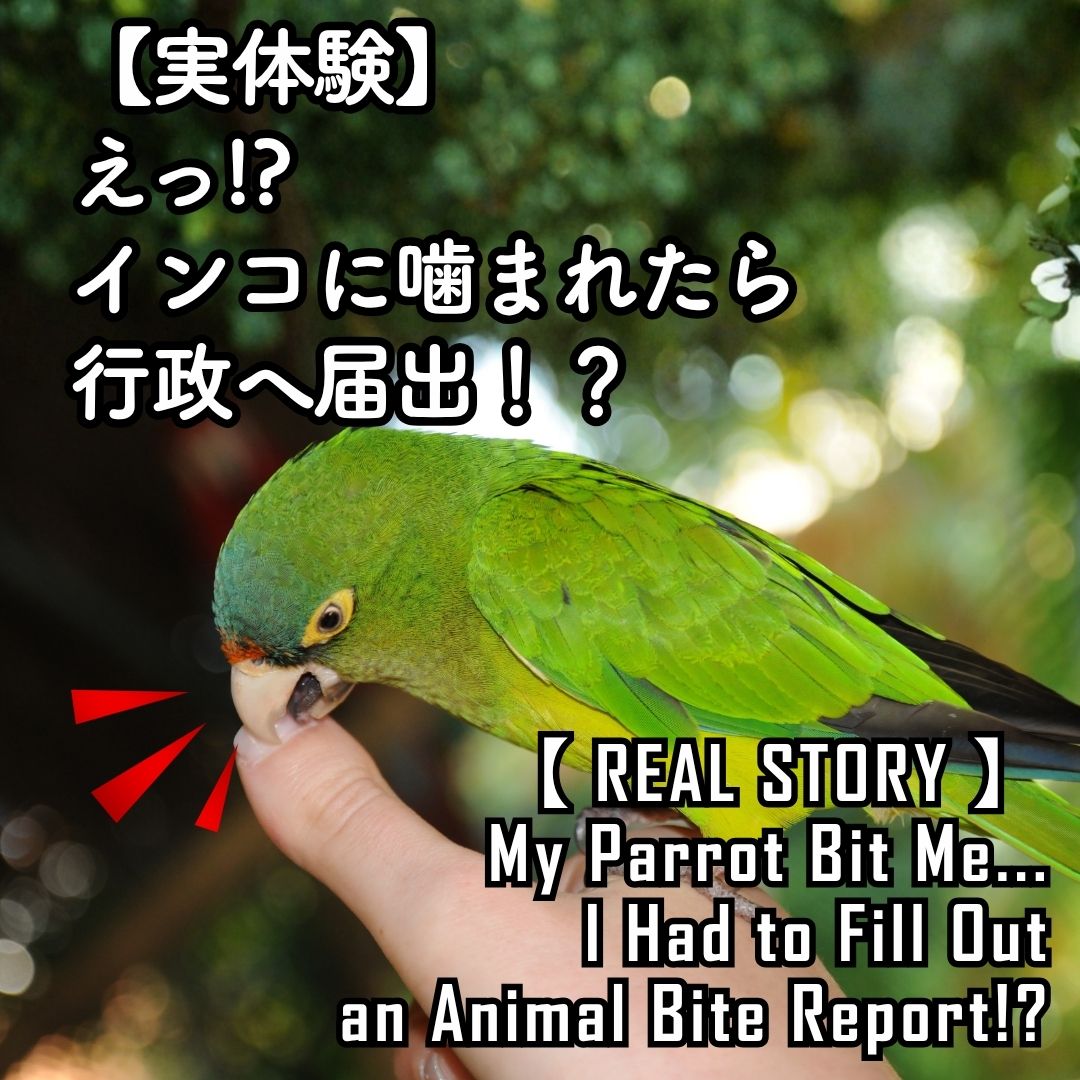
Recently, I was bitten on the finger by my parrot at home, and the wound was fairly deep.
To be honest, my bird had never bitten me even once since I brought them home. This was the first time, and I think they may have just been in a bad mood that day.
For context, please read this as a story about a parrot that is not a small parrots.
If you live with parrots, you probably already know this, but medium-sized parrots and larger birds have incredibly strong beaks. When they bite seriously, they can tear the skin and cause a surprising amount of bleeding. Of course, bites from small parakeets can still hurt too.
This time, the wound was deep and the bleeding would not stop, so I decided to go to the hospital just to be safe.
I assumed they would simply clean the wound and prescribe antibiotics if necessary.
But at the hospital, I was told something I had not expected at all.
This article is based on something a PEGO staff member actually experienced.
Because it includes topics I am not an expert in, such as U.S. laws, health insurance systems, and vaccines, I wrote this article with the help of AI so that I could explain the information as accurately as possible.
This blog was originally written in Japanese, my native language, and translated into multiple languages using translation tools. Some wording may sound unnatural, and I appreciate your understanding.
What I Was Asked First at the Hospital
The first questions I was asked were:
- What kind of animal bit you?
- Where were you bitten?
- When did the injury happen?
- When was your last vaccination?
I answered, “I was bitten by my parrot at home.”
Honestly, I thought these were just part of the standard medical intake questions, and that would be the end of it.
However, after that, the doctor handed me a form.
“Because this needs to be reported to the authorities, please fill out this form.”
Filling Out an Animal Bite Report
The form I was given was titled “Animal Bite Report.”
It asked for information such as:
- the patient’s information
- the date and time of the incident
- where I was bitten
- information about the animal
- the circumstances of the incident
In the United States, for public health reasons, including rabies prevention, many states have systems in place that require healthcare providers to report animal bites, especially bites from animals such as dogs, cats, and ferrets, to public health authorities.
I immediately asked, “Even for a parrot? Parrots are not a rabies risk, right?”
The doctor explained to me, “When someone comes to the hospital after being bitten by an animal, they are required by law to complete this report and submit it to the authorities. At our facility, this applies to all animals.”
Please note that the rules and how they are handled may vary depending on the state, local area, and medical facility.
The Report Was Submitted to the Authorities
Afterward, I looked into it and learned that although the rules and procedures vary by state and local area, most states in the U.S. have some type of system for healthcare providers to report animal bites to public health authorities.
In most cases, reporting bird bites is apparently not specifically required by law. However, at the hospital I visited, their policy was to report animal bites in general.
Because of that, even though the bite was from a bird, I still had to fill out an Animal Bite Report.
Why Animal Bites Are Reported
This may not be very familiar to people in Japan, but rabies is still found in wild animals in the United States.
Common examples include:
- bats
- raccoons
- skunks
- foxes
The purpose of this system is to monitor public health risks, including rabies.
To support that, public health authorities have systems in place to receive information about animal bite incidents.
Birds Do Not Get Rabies
One thing I want to make clear is that birds are not animals that carry or transmit rabies.
In other words, the report was not filed because there was a possibility that my parrot had rabies.
Treatment
The treatment process went like this:
- The doctor examined the wound on my hand.
- The wound was disinfected.
- Ointment was applied, and a bandage was placed over it.
- I received a vaccination.
- I was prescribed antibiotics.
Other than the vaccination, everything was pretty much what I had expected.
Getting a Tetanus Shot
“When was your last tetanus shot?”
The doctor asked me this after examining the wound.
I had never received a tetanus shot before, so I ended up getting one on the spot.
Tetanus is an infection caused by a bacterium called Clostridium tetani. The bacteria can enter the body through a wound and produce a powerful toxin. Clostridium tetani is widely found in nature, including in soil, dust, and animal feces.
The biggest concern is not the bacteria itself, but the toxin it produces. This toxin affects the nervous system and can cause severe muscle stiffness throughout the body.
The reason for getting a tetanus shot is not because birds transmit tetanus.
Rather, it is because tetanus bacteria can potentially enter the body through a deep wound.
That is why, in the U.S., healthcare providers often ask about your tetanus vaccination history when treating animal bites.
In general, a booster may be recommended if it has been more than 10 years since your last tetanus shot. For deep or contaminated wounds, a booster may be recommended if it has been more than 5 years.
From what I understand, it is not necessarily mandatory in the case of a bird bite, but in my situation, it felt almost mandatory. They really did not give me much room to say no…
A Major Difference from Japan
What surprised me the most about this experience was how different the medical process was from what I was used to in Japan, even though the situation itself was simply that I had been injured after being bitten by my own bird.
In Japan, I imagine the process would usually be something like this:
- confirming what kind of animal caused the injury
- cleaning and disinfecting the wound
- prescribing antibiotics if necessary
On the other hand, at the hospital I visited, the process was:
- confirming what kind of animal caused the injury
- filling out an Animal Bite Report
- reporting the incident to public health authorities
- checking my tetanus vaccination history
- giving a vaccination if necessary
- cleaning and disinfecting the wound
- prescribing antibiotics if necessary
This made me realize that the difference was not only in the healthcare system itself, but also in how public health is approached.
From what I learned afterward, this hospital was not necessarily doing something unusual. Many states have similar systems in place for reporting animal bites, although the details can vary depending on the state, local area, and medical facility.
What I Think Bird Owners Living Abroad Should Know
One thing I learned from this experience is that there are many systems overseas that may not exist, or may not be considered “normal,” in your home country.
Until this happened, I had never imagined that being bitten by a parrot could lead to filling out a report for the authorities.
But in reality, systems and procedures like this do exist, and they function as part of public health protection.
For people who keep birds overseas, or for those who may move abroad in the future, I think it is helpful to know that if you are injured, you may go through a process like this depending on where you live and where you receive medical care.
Closing Thoughts
This was a slightly unusual experience, but it also gave me a valuable opportunity to learn about some of the differences between Japan and the United States. Since I had never heard of this kind of response in Japan, I was honestly very surprised.
What happens in your country if you go to the hospital after being bitten by your pet bird?
If a system like this existed in Japan as well, I imagine many people reading this blog might have already experienced filling out an Animal Bite Report and getting a tetanus shot. lol
The purpose of this article is not to say, “In the U.S., if you are bitten by a parrot, you must always report it to the authorities.”
Rather, I wanted to share my personal experience: at the hospital I personally visited, this was how the situation was handled; many states have systems in place for reporting animal bites to public health authorities; and I was surprised by how different the process was from what I was used to in Japan.
I think many people in Asia rarely have a chance to hear about the everyday lives of bird owners in the United States, or about incidents like this, so I hope you can read this as a light, everyday-life blog from one of our staff members.
There are already so many medical terms I do not know even in my native language, and this time I had to deal with everything in English. I was desperately using a translation app in one hand and searching on Google with the other!
In the United States, the way animal bites are handled may vary depending on the state, local area, and medical facility.
What I experienced is only one example from the hospital I personally visited. I have also heard that even within the same state, the response can differ depending on the medical facility.
P.S.
My parrots are now targeting my bandage and scab, while I am desperately trying to protect my hand. As usual, we are having another intense battle today! lol