Introducing Herb Foraging for Parrots
A simple way to incorporate herbs naturally, even for parrots that do not drink herbal tea.
“I want to give herbs, but my parrot won’t drink herbal tea.”
“I’m worried it will go to waste if they don’t drink it.”
These are concerns we hear very often from parrot owners.
Herbs are commonly thought of as beneficial,
but many people are unsure how to introduce them in practice.
Some are also uncertain about which herbs are actually safe.
You are not alone in feeling this way.
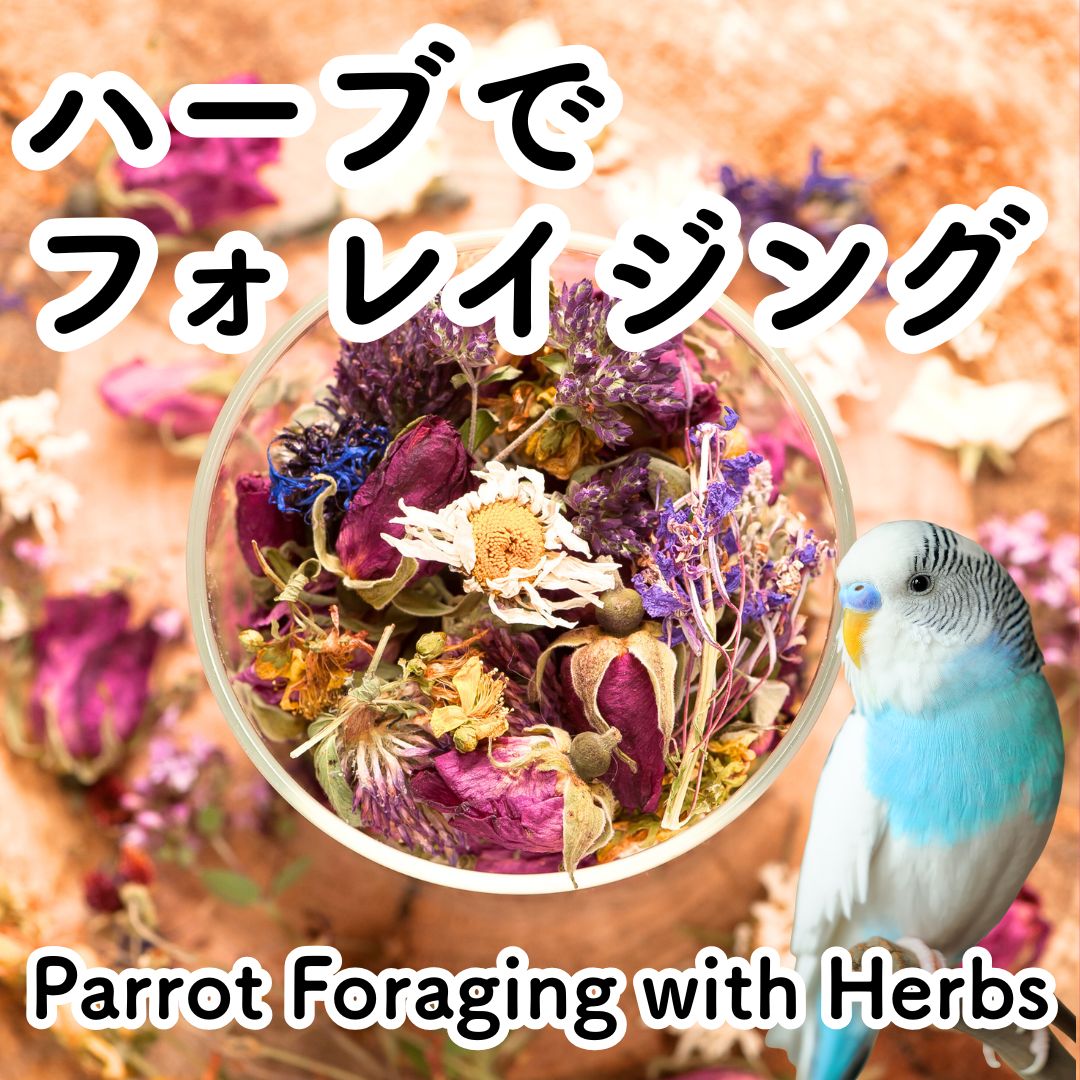
In this article, we introduce a simple foraging method using dried seeds and dried herbs as an alternative to herbal tea.
Dietary diversity is not just about “nutrition”
“Fifty percent of health comes from mental well-being.”
This is a well-known concept in parrot behavior and enrichment.
When people think about dietary diversity, they often focus only on “nutritional balance.”
However, for parrots, foraging itself—searching, avoiding, choosing, and thinking—is an important source of stimulation.
How to do herb foraging (it’s very simple)
The method is surprisingly simple.
What you will need
- Dried seeds
- A dried herb blend
- A container (it does not need to be a special foraging container)
① Prepare 1 teaspoon of dried seeds.
② Prepare 2 to 3 teaspoons of the dried herb blend; using more herbs than seeds is recommended. For this example, we used ③ Plumage Perfection Tea.
It is a recommended blend used by the PEGO staff during molting periods and for feather misting baths.
③ Mix the dried seeds and dried herbs together, place the mixture in a container, and offer it to your parrot.
Why it’s better to use more herbs than seeds
From a parrot’s perspective, this type of meal feels like this:
“I want to eat my favorite seeds, but there are ‘obstacles’ (the herbs) in the way.”
In other words, the parrot must avoid the herbs while searching for the seeds, turning mealtime into a mentally engaging activity.
Humans tend to prioritize how easy food is to eat, but parrots are the complete opposite.
Behavioral studies show that rewards obtained through effort are more satisfying than those obtained easily.
That is why deliberately making food less convenient can add value for parrots.
Why this foraging method is recommended
This method offers several benefits.
- Herbs naturally enter the beak while the parrot searches for seeds
- Parrots become familiar with herbs without being forced
- As a result, resistance to herbal tea may decrease
- Greater variety in aroma, color, and texture makes meals more enjoyable
- Regularly changing the foraging materials provides ongoing stimulation.
In addition, when eating becomes a task and a source of stimulation, it helps enrich time spent inside the cage, which can otherwise become monotonous.
Parrots are “busy creatures.”
In the wild, parrots spend much of their day searching for food.
Remaining still and doing nothing is rare in nature.
We encourage you to incorporate herb foraging as one form of enrichment to keep your parrot pleasantly occupied, starting today.
Enrichment refers to methods used to enhance a parrot’s daily life.
It helps reduce boredom and stress while encouraging natural behaviors such as searching, shredding, thinking, playing, interacting, and flying, thereby supporting both mental and physical well-being.
Important points when using herbs
When giving herbs to parrots, always confirm their safety.
Herbs that are generally considered “safe for parrots” are not necessarily safe for all parrots.
- Humans and parrots have very different physiological systems
- Some herbs are not suitable for certain parrot species
- Some combinations of herbs are not recommended
These points require careful attention.
For those who want to introduce herbs with confidence
If you feel unsure, we recommend using the herb blends available here.
These blends were developed by avian specialists with careful consideration of both parrot physiology and herb components.
All blends are suitable as foraging materials; however, we would like to introduce two blends that are specifically designed for foraging.
① Biodiversity Flower Forage (colorful flower type)
This foraging mix is composed primarily of colorful dried flowers. It is designed to encourage natural foraging behavior while allowing parrots to enjoy differences in appearance, aroma, and texture.
By turning mealtime into an engaging experience that involves searching, choosing, and avoiding, it also supports mental satisfaction. Simply adding a small amount to the regular diet is recommended for those who want to introduce variety and enjoyment into everyday life.

② Biodiversity Green Forage (subtle green type)
Recommended for parrots that are not comfortable with colorful or visually bold ingredients.
This foraging mix combines plant materials such as leaves and roots and features a calm aroma and texture. It is designed to mimic natural ground-foraging behavior, encouraging parrots to use their beaks and minds more actively. By adding a sense of work to otherwise routine cage meals, it helps prevent boredom and brings gentle stimulation to daily life. It is also easy to incorporate for parrots on seed-based diets.

We also offer a total of nine different herb blends.
All are grown without pesticides and formulated in ratios considered safe for parrots.
Please visit the product pages here for more details.
Because herbs are “natural,” it is especially important to choose and offer them based on accurate knowledge.
When using commercially available herbs, we strongly recommend confirming that they are produced with a proper understanding of herb combinations that are safe for parrots.