
Biodiversity Bird Blends Translation Series Vol. 6
번역 준비 중

Below, we share translated versions of the images above in several languages. You can view the original post here.
Pellets vs. Whole Foods: Which Is More Affordable?
Feeding parrots a whole-food diet that includes fresh vegetables, fruits, and sprouted seeds is often seen as expensive or even a luxury.
However, with thoughtful ingredient choices and smart shopping habits, it's possible to offer your bird a wide variety of fresh, whole foods at a surprisingly affordable cost. In some cases, a whole-food diet may even cost less than commercial pellets while offering potential health benefits.
In this article, we'll compare the daily, weekly, monthly, and annual feeding costs for cockatiels, African grey parrots, and macaws, based on U.S. grocery prices.
*Note: These calculations are based on U.S. food prices.
We'll also introduce specific ingredients, feeding amounts, and practical ways to keep costs down.
We hope this article helps you discover that providing your parrot with a varied, whole-food diet can be more affordable and accessible than you might expect.
The following is the original text, reproduced here for reference because this page is available in multiple languages.
----------

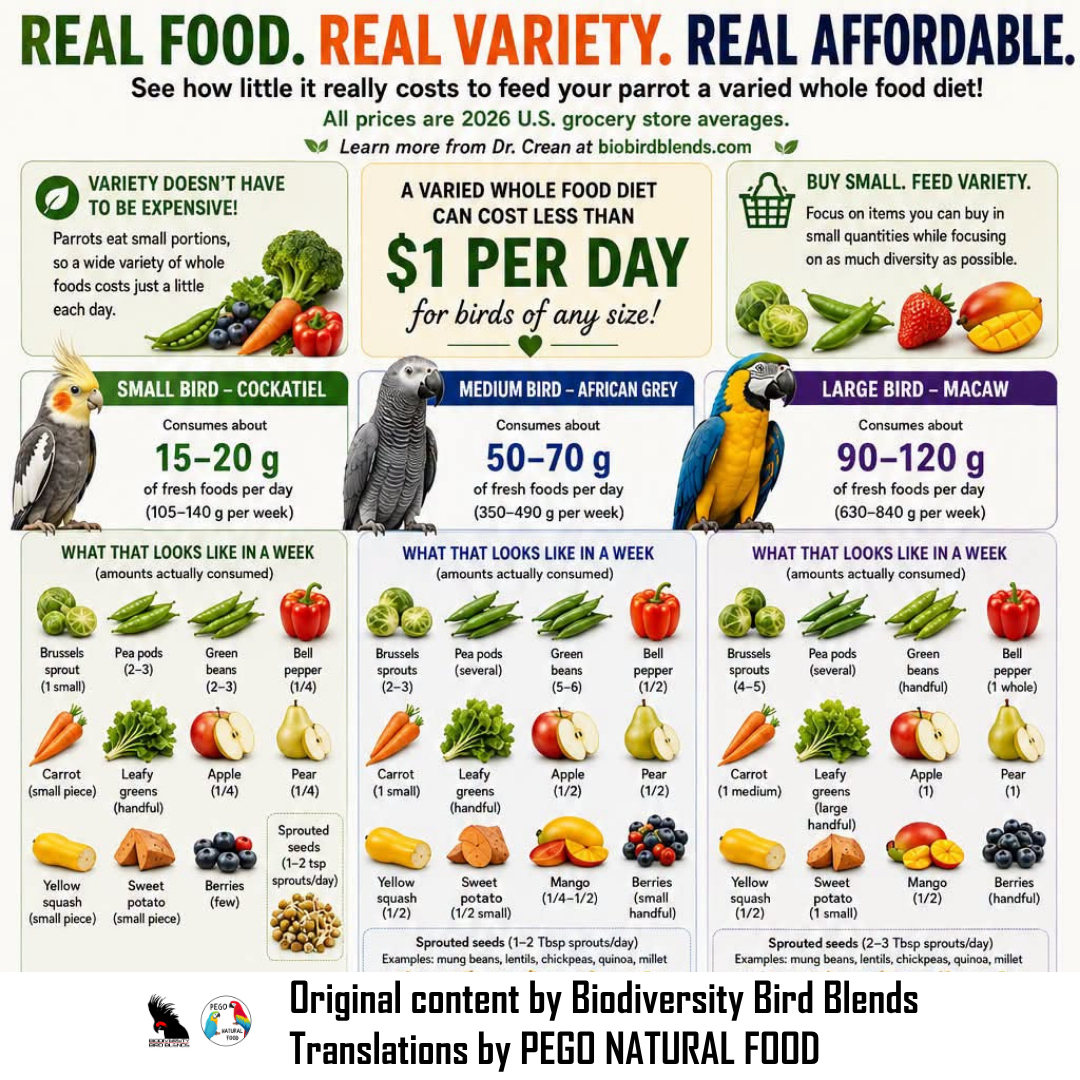
REAL FOOD. REAL VARIETY. REAL AFFORDABLE.
See how little it really costs to feed your parrot a varied whole food diet!
All prices are 2026 U.S. grocery store averages.
Learn more from Dr. Crean at biobirdblends.com
VARIETY DOESN’T HAVE TO BE EXPENSIVE!
Parrots eat small portions, so a wide variety of whole foods costs just a little each day.
A VARIED WHOLE FOOD DIET CAN COST LESS THAN
$1 PER DAY
for birds of any size!
BUY SMALL. FEED VARIETY.
Focus on items you can buy in small quantities while focusing on as much diversity as possible.

SMALL BIRD – COCKATIEL
Consumes about 15–20 g of fresh foods per day
(105–140 g per week)
WHAT THAT LOOKS LIKE IN A WEEK
(amounts actually consumed)
| Food | Amount |
| Brussels sprout | 1 small |
| Pea pods | 2–3 |
| Green beans | 2–3 |
| Bell pepper | 1/4 |
| Carrot | small piece |
| Leafy greens | handful |
| Apple | 1/4 |
| Pear | 1/4 |
| Yellow squash | small piece |
| Sweet potato | small piece |
| Berries | few |
| Sprouted seeds | 1–2 tsp sprouts/day |
WEEKLY COST OF FOOD
(based on amounts actually consumed)
Average cost of these foods:
about $0.70 – $1.10 per week
(average $0.90/week)
COST TO FEED PER DAY
| Per day | Per week | Per month | Per year |
| 10¢ | $0.90 | $3.90 | $47.45 |
MEDIUM BIRD – AFRICAN GREY
Consumes about 50–70 g of fresh foods per day
(350–490 g per week)
WHAT THAT LOOKS LIKE IN A WEEK
(amounts actually consumed)
| Food | Amount |
| Brussels sprouts | 2–3 |
| Pea pods | several |
| Green beans | 5–6 |
| Bell pepper | 1/2 |
| Carrot | 1 small |
| Leafy greens | handful |
| Apple | 1/2 |
| Pear | 1/2 |
| Yellow squash | 1/2 |
| Sweet potato | 1/2 small |
| Mango | 1/4–1/2 |
| Berries | small handful |
Sprouted seeds (1–2 Tbsp sprouts/day)
Examples: mung beans, lentils, chickpeas, quinoa, millet
WEEKLY COST OF FOOD
(based on amounts actually consumed)
Average cost of these foods:
about $1.80 – $3.00 per week
(average $2.40/week)
COST TO FEED PER DAY
| Per day | Per week | Per month | Per year |
| 34¢ | $2.40 | $10.40 | $126.65 |
LARGE BIRD – MACAW
Consumes about 90–120 g of fresh foods per day
(630–840 g per week)
WHAT THAT LOOKS LIKE IN A WEEK
(amounts actually consumed)
| Food | Amount |
| Brussels sprouts | 4–5 |
| Pea pods | several |
| Green beans | handful |
| Bell pepper | 1 whole |
| Carrot | 1 medium |
| Leafy greens | large handful |
| Apple | 1 |
| Pear | 1 |
| Yellow squash | 1/2 |
| Sweet potato | 1 small |
| Mango | 1/2 |
| Berries | handful |
Sprouted seeds (2–3 Tbsp sprouts/day)
Examples: mung beans, lentils, chickpeas, quinoa, millet
WEEKLY COST OF FOOD
(based on amounts actually consumed)
Average cost of these foods:
about $3.20 – $5.00 per week
(average $4.05/week)
COST TO FEED PER DAY
| Per day | Per week | Per month | Per year |
| 57¢ | $4.00 | $17.30 | $210.90 |

SPROUTED SEEDS ADD BIG NUTRITION FOR JUST PENNIES!
Typical cost of 1–2 Tbsp sprouts per day
| DRY SEED (EXAMPLE) | 2026 AVERAGE PRICE (PER LB) | COST FOR IN 7 DAYS (1–2 Tbsp/day) | COST PER DAY |
| Mung beans (1 lb) | $1.49 | 2 Tbsp sprouts | 4¢ |
| Lentils (1 lb) | $1.79 | 2 Tbsp sprouts | 5¢ |
| Chickpeas (1 lb) | $1.89 | 2 Tbsp sprouts | 5¢ |
| Quinoa (1 lb) | $2.49 | 2 Tbsp sprouts | 7¢ |
| Millet (2 lb) | $1.69 | 2 Tbsp sprouts | 5¢ |
Just a spoonful of sprouts each day adds enzymes, vitamins, minerals, and great fiber for pennies!

TIPS TO SAVE EVEN MORE
- Buy seasonal produce
- Choose store brands
- Visit farmers markets & local growers
- Share produce you buy for your family
- Grow greens, herbs, and sprouts at home
- Plan meals to use what you buy

2026 AVERAGE PRICES OF COMMON PRODUCE
(per individual item or small portion)
| Produce | Price |
| Brussels sprout (1 small) | $0.20 |
| Pea pods (2–3) | $0.25 |
| Green beans (handful) | $0.25 |
| Bell pepper (1 medium) | $1.15 |
| Carrot (1 medium) | $0.25 |
| Leafy greens (handful) | $0.35 |
| Apple (1 medium) | $0.70 |
| Pear (1 medium) | $0.65 |
| Yellow squash (1 small) | $0.40 |
| Sweet potato (1 small) | $0.45 |
| Mango (1 medium) | $1.10 |
| Berries (1/2 cup) | $0.75 |
Sources: 2026 average prices from Kroger, Safeway, Walmart, and Sprouts Farmers Market (May 2026). Prices vary by region and season.
IMPORTANT NOTES
- Costs vary by location and season.
- Prices based on 2026 U.S. grocery store averages.
- Amounts shown are what birds actually consume, not what is offered.
- Adjust portions for your individual bird.
- Food cost does not include supplements if used.
FEED VARIETY. FEED HEALTH. FEED SMART.
A varied whole food diet doesn’t have to be expensive.
It just takes a little knowledge and a little creativity.
----------------
Below is a translation of the original caption. View the original post here.
🌱🦜 IT’S FORAGING FRIDAY!
💰 Feeding fresh doesn’t have to be expensive.
One of the biggest misconceptions about feeding parrots a diverse whole-food diet is that it costs a fortune. It doesn’t—especially when you shop strategically. And it’s cheaper than most pellets… and a heck of a lot healthier, too!
🌱 SPROUTING IS ONE OF THE MOST AFFORDABLE WAYS TO ADD FRESH FOOD.
A small amount of dry seed can produce a surprisingly large amount of living, fresh food after soaking and sprouting. Lentils, mung beans, millet, buckwheat, wheat, quinoa, and other sproutable seeds can be purchased inexpensively, stored for long periods, and sprouted in small batches as needed.
And remember: your bird only eats a small amount!
🥕 Instead of buying large bags of produce, focus on foods you can purchase individually or in small quantities:
🫑 1 bell pepper
🥕 1 carrot
🍐 1 pear
🍎 1 apple
🥭 1 mango
🥒 1 zucchini or yellow squash
🌱 A handful of green beans or peapods
🥬 A few Brussels sprouts
🍠 1 small sweet potato (yes, raw!)
🫐 A small container of berries
🌿 Small bunches of leafy greens
One pepper can contribute to several meals. One carrot can last multiple days. A few Brussels sprouts, green beans, berries, and peapods can provide even more variety without buying more food than your bird can eat.
🌈 The goal isn’t to buy a lot of each food—it’s to buy SMALL AMOUNTS of MANY foods.
Combine individually purchased produce with inexpensive sprouts, soaked seeds, herbs, edible flowers, and other whole foods, and you can create tremendous dietary diversity for surprisingly little money.
💡 Shop smart. Buy small. Sprout often. Rotate constantly.
Your bird gets variety, texture, moisture, color, phytonutrients, and opportunities to forage—without a huge grocery bill.
🌱🦜 Fresh food is affordable food.
Check out the options at the shop link in our bio
----------
The above is the original article by Biodiversity Bird Blends.
The following tables were prepared by our store to compare feeding costs based on the retail prices of commercially available bird pellets in the United States.
Pellet Feeding Cost Comparison
Prices are based on U.S. retail prices as of November 2026.
| Bird Species | Per Day | Per Week | Per Month | Per Year |
|---|---|---|---|---|
| Brand A | ||||
| Cockatiel | $0.32 | $2.25 | $9.63 | $117.16 |
| African Grey | $1.10 | $7.70 | $33.02 | $401.70 |
| Macaw | $1.93 | $13.48 | $57.78 | $702.97 |
| Brand B | ||||
| Cockatiel | $0.46 | $3.23 | $13.83 | $168.27 |
| African Grey | $1.58 | $11.06 | $47.42 | $576.93 |
| Macaw | $2.77 | $19.36 | $82.98 | $1,009.62 |
| Brand C | ||||
| Cockatiel | $0.61 | $4.29 | $18.40 | $223.90 |
| African Grey | $2.10 | $14.72 | $63.10 | $767.67 |
| Macaw | $3.68 | $25.76 | $110.42 | $1,343.43 |
| Brand D | ||||
| Cockatiel | $0.81 | $5.67 | $24.28 | $295.46 |
| African Grey | $2.78 | $19.43 | $83.26 | $1,013.00 |
| Macaw | $4.86 | $34.00 | $145.70 | $1,772.74 |
For each feeding range, the midpoint between the minimum and maximum estimated costs was used as the average.
Whole Food Feeding Cost Comparison
| Bird Species | Per Day | Per Week | Per Month | Per Year |
|---|---|---|---|---|
| Cockatiel | 10¢ | $0.90 | $3.90 | $47.45 |
| African Grey | 34¢ | $2.40 | $10.40 | $126.65 |
| Macaw | 57¢ | $4.00 | $17.30 | $210.90 |
How Feeding Costs Were Calculated
The tables above compare the estimated daily, weekly, monthly, and annual costs of feeding whole foods and commercially available pellets, based on purchase prices and daily feeding amounts.
Pellet costs were also calculated using the following daily feeding amounts:
・Small parrots: Approximately 15–20 g per day
・Medium-sized parrots: Approximately 50–70 g per day
・Large parrots: Approximately 90–120 g per day
Actual costs will vary depending on the retailer, manufacturer, shipping fees, net weight, bird species, and daily feeding amounts. These are simplified estimates intended to provide a general reference rather than exact feeding costs.
If you're looking for ways to reduce the cost of caring for your bird, we recommend taking a closer look at what you're feeding them.
Switching to a whole-food diet can be easier on your wallet while also offering potential health benefits. And one of the best parts? You can enjoy many of the same fresh, wholesome foods alongside your feathered companion!
----------
We translate and share posts from Biodiversity Bird Blends in multiple languages for bird owners who may find English difficult, as well as for those who want to explore a wider range of bird care information from around the world. We also encourage you to check out our other translated articles.
We also carry Biodiversity Bird Blends products in our store. We offer international shipping, so please feel free to contact us in your preferred language. International wholesale orders are also welcome.
