
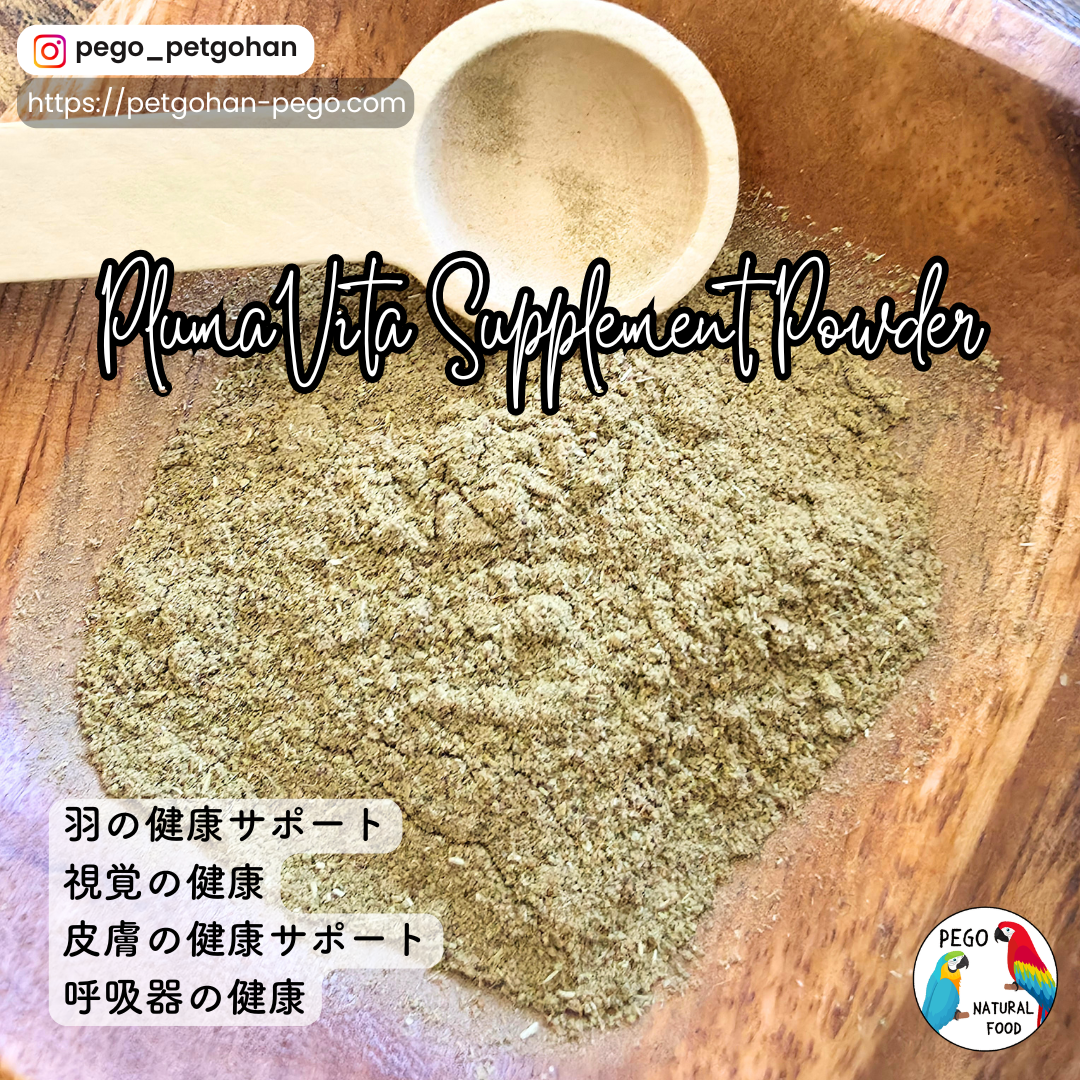
⑰ PlumaVita™ Avian Whole Food Supplement Powder
Tax included.
Carefully formulated to include items that have been known to support skin, feathers and eyes.
Biodiversity Bird Blends is dedicated to improving the lives of the animals we keep through whole food nutrition. We rely on the decades of science that has shown us the value of biological compounds in whole food items and the dangers of processed foods. We also rely on experts in avian nutrition who run our formulations and create our innovative products to ensure their safety and benefits for all animals. As both Dr. Jason and Dr. Karen have long said, we want our animals to THRIVE, not just survive.
Product Overview
Species
Suitable for small, medium, and large parrots.
Not suitable for Eclectus parrots, lorikeets, or toucans.
Feeding Instructions
Instructions for use: Offer 1 scoop (1/3 tsp) to each ½ cup moist foods. Best to sprinkle over food and mix in just prior to feeding.
This is not a substitute for staple food. Please sprinkle it over regular meals or mix it with treats and other foods.
As it is not a medicine, there are no strict rules regarding frequency or timing.

Ingredients
Carrot powder*, Pumpkin fruit powder*, Green pumpkin seed powder*, Nettle leaf powder*, Calendula powder*, Wheatgrass powder*, Alfalfa powder*, Chamomile flower powder*, Kelp powder*.
*denotes organic ingredient
Estimated Guaranteed Analysis
(per 100 g dry product – formulation estimate):
Nutrient Estimated Level:
Crude Protein 14–16%
Crude Fat 3–5%
Crude Fiber 10–12%
Moisture ≤10%
Ash 10–12%
Calcium 1.8–2.7%
Phosphorus 0.25–0.45%
Iodine 25–45 ppm
Beta-carotene equivalent 22,000–27,000 IU/kg
Lutein + Zeaxanthin 12–22 mg/100 g
The Science Behind Our Ingredients
Some of the science behind the ingredients we use:
1. Vitamin A / Beta-Carotene (Feather, Skin, Vision, Immune Health)
Relevant ingredients:
Carrot powder, pumpkin powder, leafy greens (nettle, alfalfa, wheatgrass)
Key claims supported
Beta-carotene is a precursor to vitamin A
Vitamin A supports epithelial tissue integrity, vision, and immune function in birds
Vitamin A deficiency leads to poor feather quality and epithelial disorders
References
Koutsos, E. A., Matson, K. D., & Klasing, K. C. (2001).
Nutrition of birds in the order Psittaciformes: a review.
Journal of Avian Medicine and Surgery.
Klasing, K. C. (1998).
Comparative Avian Nutrition.
CAB International.
McDowell, L. R. (2000).
Vitamins in Animal and Human Nutrition.
Iowa State University Press.
Koutsos, E. A. (2016).
Vitamin A and carotenoid nutrition in birds.
Supporting context: vitamin A is essential for vision, reproduction, immune function, and epithelial tissue maintenance in birds.
Beta-carotene-rich vegetables such as carrots and pumpkin provide a safe dietary source of vitamin A precursors for birds.
2. Carotenoids (Lutein, Zeaxanthin) and Feather Pigmentation
Relevant ingredients:
Marigold (Calendula), carrot, pumpkin, leafy greens
Key claims supported
Carotenoids act as antioxidants
Contribute to pigmentation and coloration in birds
Support eye health
References
McGraw, K. J. (2006).
Mechanics of carotenoid-based coloration in birds.
Bird Coloration: Mechanisms and Measurements.
Surai, P. F. (2002).
Natural antioxidants in avian nutrition and reproduction.
Nottingham University Press.
Olson, V. A., & Owens, I. P. (1998).
Costly sexual signals: are carotenoids rare, risky or required?
Trends in Ecology & Evolution.
Birds commonly use carotenoid pigments for coloration of feathers and tissues.
3. Functional Mushrooms (Lion’s Mane, Reishi) – Neuroprotection and Immune Support
Relevant ingredients:
Lion’s Mane (Hericium erinaceus)
Reishi (Ganoderma lucidum)
Key claims supported
Lion’s Mane compounds stimulate nerve growth factor (NGF)
Mushroom β-glucans support immune modulation
Mushroom polysaccharides provide antioxidant effects
References
Friedman, M. (2015).
Chemistry, nutrition, and health-promoting properties of Hericium erinaceus.
Journal of Agricultural and Food Chemistry.
Wasser, S. P. (2010).
Medicinal mushroom science: current perspectives.
Applied Microbiology and Biotechnology.
Heleno, S. A. et al. (2015).
Bioactive compounds from mushrooms: nutritional and medicinal potential.
Food Chemistry.
Mushroom polysaccharides such as β-glucans show antioxidant and antimicrobial activity in experimental studies.
4. Milk Thistle (Silybum marianum) – Liver Protection
Relevant ingredient:
Milk thistle seed powder
Key claims supported
Silymarin complex has hepatoprotective properties
Antioxidant effects help protect liver cells
Used in both human and animal liver support research
References
Abenavoli, L. et al. (2010).
Milk thistle for treatment of liver disease.
American Journal of Medicine.
Federico, A., et al. (2017).
Silymarin in liver diseases: mechanisms and clinical applications.
Phytotherapy Research.
Tedesco, D. et al. (2004).
Silymarin, a possible hepatoprotective compound in animal nutrition.
Animal Feed Science and Technology.
Silymarin derived from milk thistle has antioxidant and hepatoprotective propertieswidely studied in liver disease models.
Milk thistle is also used in animal feed additives for liver support.
5. Oregano (Carvacrol, Thymol) – Antimicrobial and Gut Health
Relevant ingredient:
Oregano powder
Key claims supported
Carvacrol and thymol possess antimicrobial activity
Can influence gut microbial balance in animals
Used in poultry nutrition as a phytogenic additive
References
Burt, S. (2004).
Essential oils: their antibacterial properties and potential applications in foods.
International Journal of Food Microbiology.
Hashemipour, H. et al. (2013).
Effect of thymol and carvacrol on broiler performance and gut health.
Animal Feed Science and Technology.
Windisch, W. et al. (2008).
Use of phytogenic products as feed additives for poultry.
Journal of Animal Science.
Experimental poultry studies show oregano-derived compounds can affect intestinal health and nutrient absorption.
6. Hibiscus – Antioxidant and Cardiovascular Support
Relevant ingredient:
Hibiscus flower powder
Key claims supported
Anthocyanin antioxidants
Anti-inflammatory and antioxidant properties
References
Da-Costa-Rocha, I. et al. (2014).
Hibiscus sabdariffa L. – A phytochemical and pharmacological review.
Food Chemistry.
Hopkins, A. L. et al. (2013).
Antioxidant and anti-inflammatory effects of Hibiscus extracts.
Phytomedicine.
Anthocyanins in hibiscus are potent antioxidants that help protect cells from oxidative damage.
7. Nettle (Urtica dioica) – Mineral Density and Antioxidant Activity
Relevant ingredient:
Nettle leaf powder
Key claims supported
High mineral density (iron, magnesium, calcium)
Antioxidant phytochemicals
References
Chrubasik, J. E., Roufogalis, B. D., & Chrubasik, S. (2007).
A comprehensive review on Urtica dioica.
Phytomedicine.
Gülçin, I. et al. (2004).
Antioxidant activity of Urtica dioica extracts.
Journal of Ethnopharmacology.
8. Marshmallow Root – Gastrointestinal Mucilage Support
Relevant ingredient:
Marshmallow root powder
Key claims supported
High mucilage content
Soothing effect on gastrointestinal mucosa
References
Al-Snafi, A. E. (2013).
The pharmacological importance of Althaea officinalis.
International Journal of Pharmaceutical Sciences Review.
Mills, S., & Bone, K. (2013).
Principles and Practice of Phytotherapy.
9. Adaptogenic Herbs (Tulsi, Chamomile)
Tulsi (Holy Basil)
References
Cohen, M. (2014).
Tulsi – Ocimum sanctum: a herb for all reasons.
Journal of Ayurveda and Integrative Medicine.
Chamomile
McKay, D. L., & Blumberg, J. B. (2006).
Chamomile: a herbal medicine with a bright future.
Molecular Medicine Reports.
These herbs show anti-inflammatory, antioxidant, and calming properties.
10. Kelp – Iodine and Trace Minerals
Relevant ingredient:
Kelp powder
Key claims supported
Provides iodine necessary for thyroid function
Supplies trace minerals
References
Holdt, S. L., & Kraan, S. (2011).
Bioactive compounds in seaweed: functional food applications.
Journal of Applied Phycology.
Teas, J. (2004).
Seaweed consumption and iodine nutrition.
Thyroid.
Quality
Biodiversity Bird Blends relies on experts in animal nutrition to carefully and safely formulate our blends. We do NOT simply mix random items in bags without considering the impact each ingredient will potentially have on your animals. We use the absolute best quality ingredients and inspect every batch carefully. Our goal is to improve the lives of the animals with which we share our lives and appreciate your trust in us and our products.
Tea blends consist of organic matter and, therefore, can spoil once wet like all other foods. It is not recommended to use tea at room temperature for extended periods of time and should be left out as long as fresh foods would be left out (up to 8-12 hours depending on environment). It is also critical that animals have access to clean water for at least part of every day. All teas are safe for animals to bathe in though some staining may occur dependent upon the ingredients contained within that blend. Tea blends may be used dry and mixed with fresh and dry foods but the true benefits come when tea is steeped and consumed as a liquid.
What are Whole Foods?
In bird nutrition, “whole foods” are ingredients that wild birds could obtain in nature—fresh vegetables and fruits, seeds, nuts, herbs, coconut, edible flowers, insects, and items that are soaked or sprouted. In short, foods you can recognize at a glance.
With the exception of processed products such as pellets, supplements, and bird cookies, most of these are considered whole foods. (Seeds count as whole foods, too.)
Best-By Date/Storage Instruction
Please refer to this page.
Store in a cool, dry place at room temperature, sealed tightly.
Once opened, please use as soon as possible regardless of the best-by date.
FAQ
Please read this page. It will likely answer many of your questions.
Caution
Herbal tea blends are made from organic ingredients and, like other foods, can spoil quickly once soaked in water. Leaving them at room temperature for extended periods is not recommended. Depending on environmental conditions, please treat them as you would fresh food and use within 8–12 hours as a guideline. It is also important that animals have access to clean water for at least part of the day. All blends can also be used for bathing, but depending on the ingredients, they may cause slight coloration. Tea blends can be sprinkled dry onto food; however, the true benefits are obtained when given as an infusion.
Herbs are not medications and therefore do not guarantee any effects.
The effectiveness of this product has not been confirmed by FDA-approved research.
It is not intended to diagnose, treat, cure, or prevent any disease.
In the United States, the Food and Drug Administration (FDA) sets maximum permissible levels of insect fragments in foods. These levels vary depending on the type of food and manufacturing process. Since this product is pesticide-free and additive-free, the possibility of insects being present cannot be completely ruled out. Insects attached to herbs are considered a source of animal protein and are not harmful to birds; however, if you are concerned, please remove them before feeding. Please note that returns or exchanges cannot be accepted due to the presence of insects.
This site’s text is automatically generated by a translation tool and may contain awkward phrasing. Thank you for your understanding.