
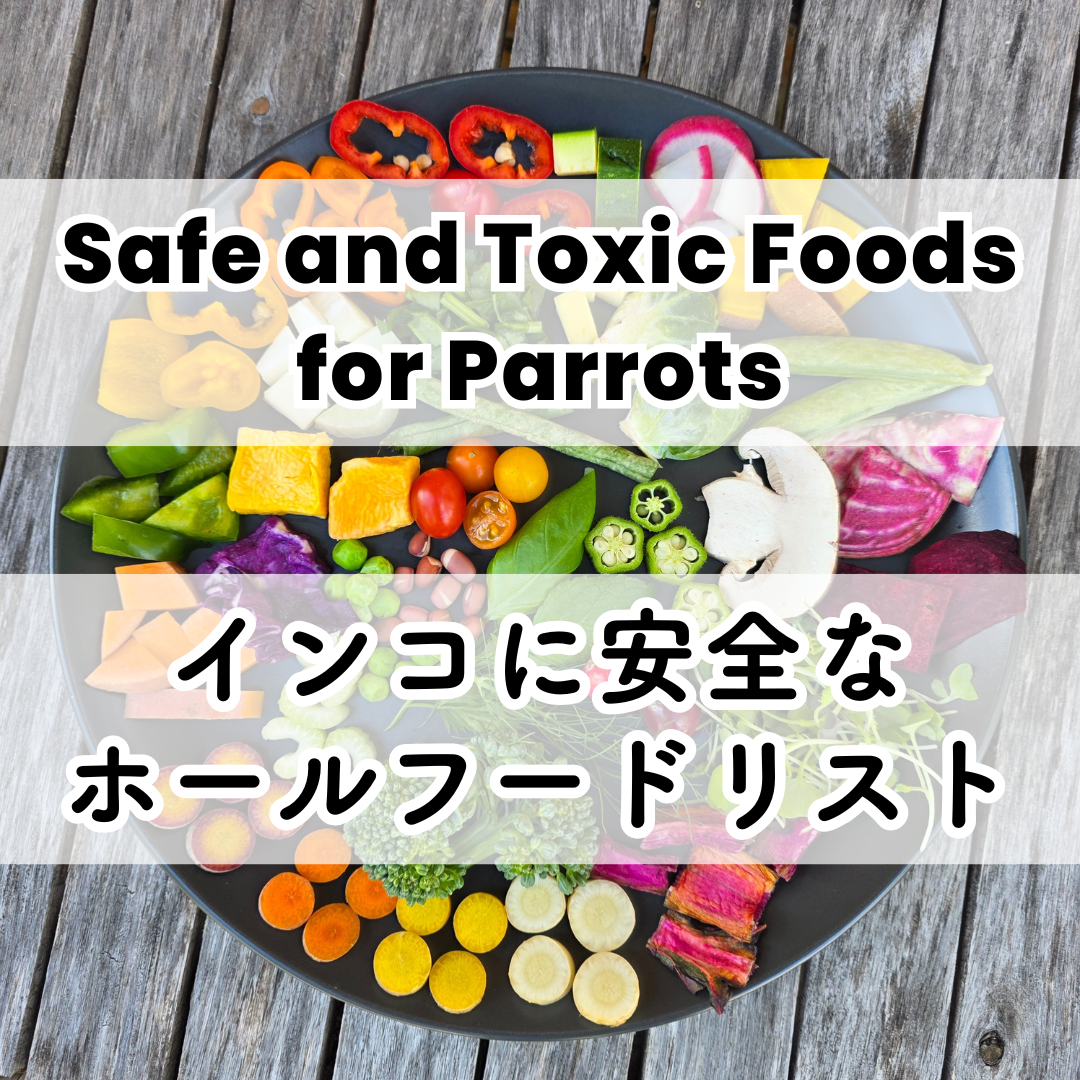
This is a list of whole foods that can be safely given to birds.
For lories and lorikeets, please research and make your own judgment. For other species, all items on this list are considered safe to feed.
This list reflects information available as of June 2026. It will be updated periodically, so please check this page regularly instead of copying or taking screenshots.
Legumes should not be fed raw or boiled. Please offer them only after sprouting.
Even healthy foods can be harmful when given in excess—balance is key. If you are unsure about appropriate portions, we recommend offering around 10% of the total daily diet (excluding items such as kelp, bee pollen, or herbs).
SAFE FOODS
Please feed all of them raw
Adzuki bean
Alfalfa leaf
Almond
Anise Seed
Apples(no need to feed seeds, but they are not harmful in small amounts)
Asparagus
Baby chard
Baby kale
Baby spinach
Bananas
Barley
Bee pollen
Beetroot
Blueberry
Brazil Nuts
Broccoli
Brown Mustard seeds
Brown rice
Buckwheat
Burdock
CO2 decaffeinated green tea
Canary Grass Seed
Canola Seed
Caraway Seed
Carrots
Cashews
Cauliflower
Cayenne pepper
Celery
Chamomile
Cherry
Chia seeds
Cinnamon (True Ceylon)
Coconut
Coriander
Cornflower
Cranberries
Crickets
Cucumber
Cumin
Daikon Radish
Dandelion
Echinacea purpurea (herb and root)
Elderberry
Fennel
Fennel seed
Fig
Filberts (Hazelnuts)
Flaxseed
French lentil
Garbanzo
Goji berry
Golden Millet
Green Beans
Green Bell Peppers
Green Peas
Green lentil
Hibiscus
Hulless Barley
Japanese Millet
Jasmine flower
Kale
Kamut
Kelp
Mushroom
Mung beans
Mealworms
Milkthistle seeds
Pitaya fruit
Quinoa
Radish
Rainbow carrot
Raisins
Raspberry
Rama holy basil (tulsi)
Red Bell Peppers
Red Millet
Red cabbage
Red clover
Red lentil
Rolled oats
Rose hips
Rose petal
Rosemary
Rye Berries
Safflower Seed
Sesame
Spelt
Spinach
Star anise
Strawberry
Sugar snap
Sunflower Seed
Sweet potato
Thyme
Tomato
Triticale
Walnuts
White Millet
Yarrow
Yellow bell pepper
Yellow squash
Young corn
Zucchini
TOXIC (Do not feed under any circumstances)
Alcohol
Avocado
Oleander
NOT recommended (We advise against feeding)
All types of meat (including dried fish)
Allium vegetables (e.g., onions, leeks)
Boiled eggs
Bread products
Canned foods (risk of heavy metals)
Cassia cinnamon
Dairy products
Edamame
Fava beans
Frozen mixed vegetables
Honey
Kidney beans
Laurel (Bay leaf)
Molokhia (Jew's mallow)
Peanuts
Potatoes
Propolis
Rhubarb
Roasted soy flour (Kinako)
Soy products
Table food (human food)
Tofu
Artificial colorings (especially Yellow No. 5, Yellow No. 6, Red No. 40, Blue No. 1, etc.)
Frozen mixed vegetables are often pre-cooked before freezing, so commercially available frozen mixed vegetables are not recommended.
----------------

The “TOXIC” list includes items that must never be fed. The “NOT RECOMMENDED” list contains foods that should generally be avoided. While these items may not cause immediate harm, they can place stress on a bird’s body, burden the liver, or disrupt hormonal balance. Only foods that are fundamentally unsuitable for avian health are included.
When customers ask about foods on the “NOT RECOMMENDED” list, we often explain it simply by saying it’s like pizza. A small amount won’t usually cause any immediate problems if a bird eats it, but it’s better not to offer it intentionally or on a regular basis.
There may be differences of opinion, but rather than thinking “this is wrong in my country” or “it’s different from overseas,” try to consider why certain foods are not recommended and weigh the pros and cons before deciding.
If you’re unsure about other foods, start by using this list to gradually expand the variety of safe items your bird can enjoy.

If you want to offer herbs safely to your bird, we recommend the herbs in the Biodiversity Bird Blends collection. Herbs can act like medicine. Simply mixing “bird-safe herbs” does not guarantee benefits; for example, ingredients like lavender require carefully calculated ratios. If you want to feed herbs with confidence, please give these a try. A portion of sales supports avian nutrition research in the United States.
For a list of edible flowers that are safe for birds, see this post.
For a veterinarian’s caution regarding processed foods (pellets), see this post.
For tips on choosing cookware that is safe for parrots, see this post.
For downloadable PDF advice on bird diets, see this post.
We are most active on Instagram. We would appreciate your follow: @pego_petgohan
----------------

