
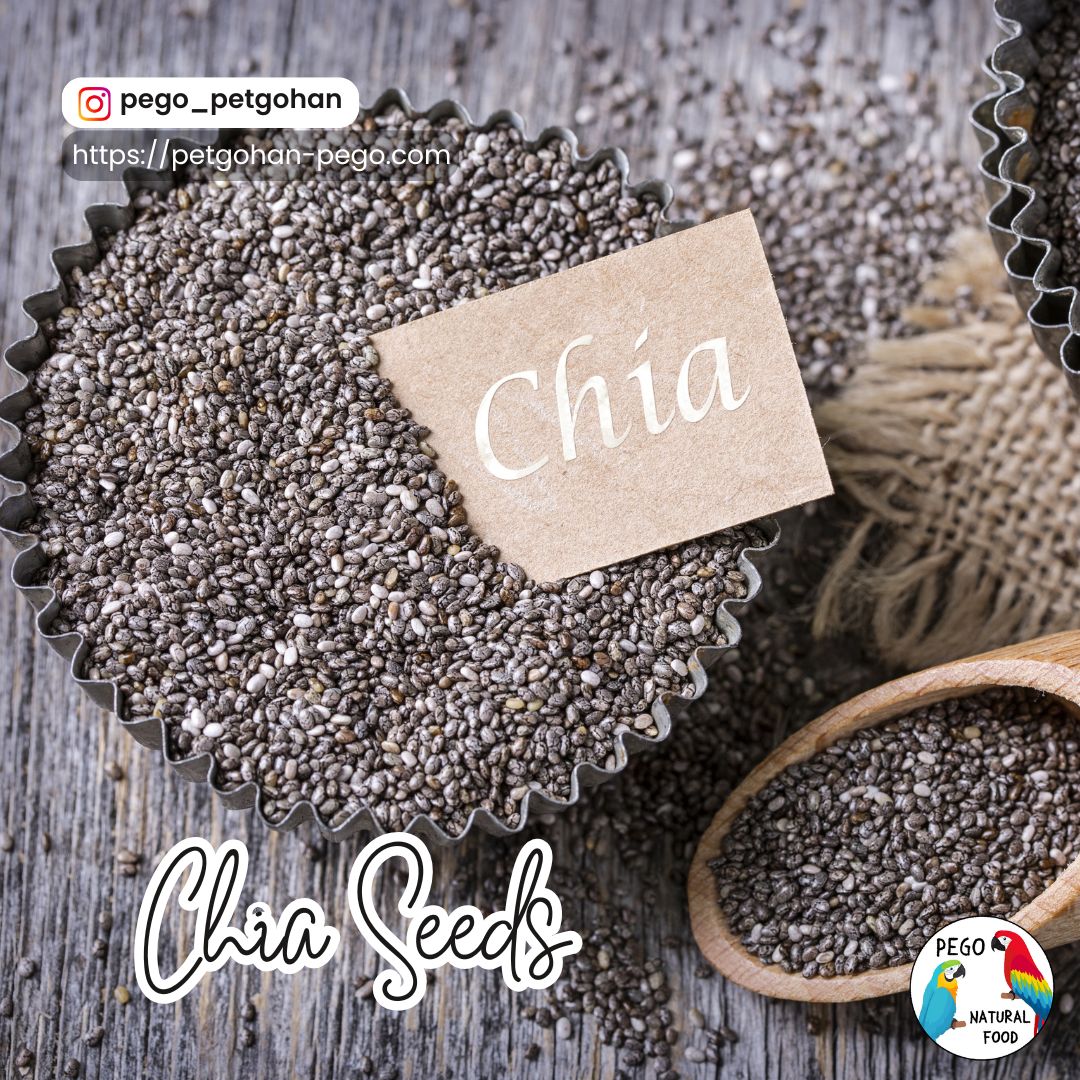
Chia Seeds
Impuestos incluidos.
Small seed, big flexibility.
Chia seeds are a versatile whole food that adds moisture, texture, and variety with just a small amount.
When soaked, they absorb water and form a soft, gel-like texture that blends easily with vegetables, soaked foods, or mixed meals. Neutral in flavor and easy to use, chia seeds are a simple way to enhance hydration and diversity in seed-, pellet-, or whole-food feeding plans—without changing the core diet.
This product is suitable for:
- Birds fed seed-based, pellet-based, or mixed diets
- Caregivers looking to add hydration and texture to meals
- Feeding plans that emphasize variety without increasing volume
- Mixing with fresh foods, soaked ingredients, or soft meals
- Rotational whole-food feeding and enrichment-focused diets
Product Overview
What is Chia Seed?
Chia seeds are the seeds of Salvia hispanica, a plant in the mint family, and have been consumed in Central and South America since ancient times. They were cultivated in the Mesoamerican region as far back as roughly 3,500 years ago, and historical records show that they were an important food source for the ancient Aztec and Maya civilizations.
Parrot Species
Suitable for a wide range of birds, including finch, budgerigars, cockatiels, and medium- to large-sized parrots.
Because it is unclear whether this is suitable for lories and lorikeets, please use your own discretion when offering it.
Other small animals may be able to enjoy these as well—please review the ingredients and use your discretion as the owner.
What Are Whole Foods?
In bird nutrition, “whole foods” are ingredients that wild birds could obtain in nature—fresh vegetables and fruits, seeds, nuts, herbs, coconut, edible flowers, insects, and items that are soaked or sprouted. In short, foods you can recognize at a glance.
With the exception of processed products such as pellets, supplements, and bird cookies, most of these are considered whole foods. (Seeds count as whole foods, too.)
Feeding Instructions
・Soak in water for about 30 minutes to 4 hours.
・Sprinkle over fresh vegetables.
・Mix into your bird’s regular seed mix.
・Use as part of a foraging setup.
You can use chia seeds just like other seeds. However, because chia absorbs more water than most seeds, we recommend soaking them before feeding so they do not draw moisture from your bird’s body after eating. For details on how to soak, please refer to our Soak guide.
If you do not have time to soak them, sprinkling chia seeds over fresh vegetables or fruits is a good option, as they will absorb the moisture from the food.
These are not sprouting-grade seeds, so we do not recommend using them for sprouting.
Feeding Amount
It can be fed daily as long as the amount is appropriate. During molting, we recommend offering a slightly larger portion than usual.
This ingredient falls under the “Dried Foods” category shown in the upper-left. Please refer to the feeding amount chart below the graph and offer it as part of a variety of dried foods.


Avian experts recommend the following amounts as a general guideline:
Small parrots: 1 tablespoon
Medium parrots: 2 tablespoons
Large parrots: 3 tablespoons
Suggested routine:
In the morning, aim to offer foods with higher moisture content.
Morning: A variety of fresh, raw whole foods
Evening: Freeze-dried food
Pellets should make up no more than 30% of the total diet, or be used simply as treats.
Storage Instructions
Store at room temperature, away from heat and humidity. Once opened, use promptly; reseal the zipper tightly or transfer to an airtight container. For reference, our team keeps it in airtight jars from IKEA.
Ingredients
Gluten free
Nutritional Benefits
Improves gut health and supports digestion
Enhances feather shine
Supports healthy skin, plumage, and brain function
Helps with feather regrowth and muscle maintenance
Keeps birds feeling full for longer
Rich in omega-3 fatty acids
Even better when fed after soaking.
Best-By Date
Please refer to this page.
Once opened, please use it as soon as possible, regardless of the best-before date.
Certified
100% pure and organic.
USDA-certified, ensuring it is completely free from pesticides, synthetic chemicals, and artificial additives.
Minimally processed, non-GMO, and gluten-free.
Suitable for both vegetarians and vegans.
FAQ
Q: Can I feed chia seeds without soaking them?
A: Yes, that is completely fine. Soaking is recommended because it offers additional benefits, but it is not required. Please see our Soak Guide for instructions.
Q: Will my bird become dehydrated if I don’t soak the chia seeds?
A: It is possible. If chia seeds are fed in very large amounts—as if they were the main part of the diet—they could potentially draw moisture from the digestive tract. However, when fed in appropriate amounts as just one part of the overall diet, the risk is low. In that case, simply make sure your bird is drinking water properly.
Q: Are these safe for humans to eat?
A: Our shop is a Parrot Food Shop, and we sell this product specifically as bird food. Whether it is suitable for human consumption depends on the packaging and the manufacturer’s information you receive after purchase, so please make your own judgment.
Q: Do chia seeds make birds gain weight because they are high in fat?
A: No. Please check the Nutrition Facts on the ingredients list. Chia seeds are indeed high in fat, but about 75 percent of that fat is polyunsaturated fatty acids, mainly omega-3s. These fats are less likely to be stored as body fat, and studies show they actually promote fatty acid oxidation, meaning they help fat burn more efficiently.
Not all fats behave the same way. What matters is not simply “how much fat,” but what type of fat it is.
Caution
The information on this page regarding nutrients, benefits, and other characteristics (including commonly stated effects) is provided as general, publicly known information about each ingredient. It does not guarantee any specific effects or results of this product.
In the United States, the Food and Drug Administration (FDA) sets maximum “defect action levels” for incidental insect matter, and those limits vary by food type and manufacturing process. Because this product uses pesticide-free ingredients and contains no additives, incidental insects may occasionally be present. Insects associated with produce or herbs (i.e., whole foods) are a natural source of animal protein and are generally not harmful to birds; however, please remove them if you prefer. Returns or exchanges cannot be accepted for issues related to incidental insects.
El texto de este sitio se genera automáticamente con una herramienta de traducción y puede contener redacciones poco naturales. Gracias por su comprensión.