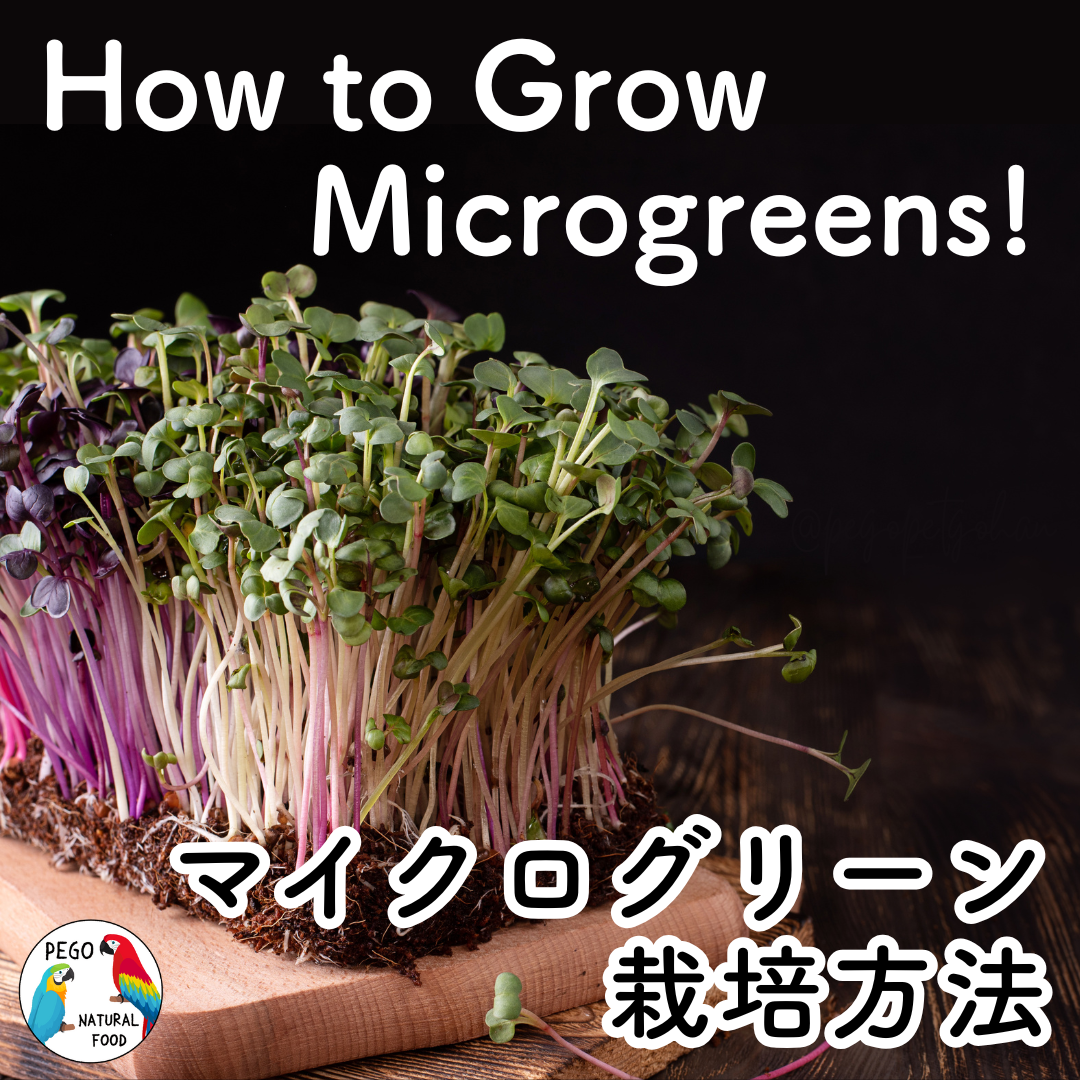
Microgreens are young vegetables harvested shortly after they sprout. In Japan, many people are familiar with pea shoots, so it may be easy to picture what microgreens are like. Pea shoots are also a familiar food for birds, so many birds are likely to accept microgreens without hesitation.
Microgreens often contain higher levels of various nutrients than mature vegetables, including vitamin A (beta carotene) and minerals. From a nutrition standpoint, they can be a very nutrient dense food.

Why are microgreens recommended?
- They tend to be more nutrient-dense than mature vegetables.
- Even birds with a small appetite may be able to obtain meaningful nutrients from a small serving.
- They can be rich in vitamin C and may provide strong antioxidant support.
- They can be high in beta-carotene, which the body converts into vitamin A.
- They can be a good source of vitamin K.
- They can contain high levels of carotenoids.
- They can contain polyphenols and may have strong antioxidant activity.
- They provide a compact source of dietary fiber, which can support digestion and a healthy gut environment.
- In some cases, certain amino acids may be present at higher levels than in mature vegetables.
- Their nutrient profile can be relatively consistent and easier to predict.
Beyond nutrition, there is another important reason soaking is so well suited for birds. This is the same concept as sprouting.
Aside from nutrition, the main reason is that they are the most suitable form of food for birds.
Did you know that wild birds rarely eat completely dry seeds (reference)? What most wild birds actually eat are seeds that contain moisture from rain or morning dew. They commonly consume damp seeds found on the ground, seeds that have just started to germinate, and moist roots that they dig up.
In captivity, birds are often fed fully dried seeds, but this is not something they frequently encounter in the wild. The same goes for vegetables, fruits, flowers, leaves, nuts, and insects. They eat many types of foods, but usually in their fresh and hydrated form.
Because companion birds are not domesticated and their bodies remain similar to those of their wild counterparts, we strongly recommend providing food that resembles what they would eat in nature (reference).
Note: Domestication refers to genetic and breeding changes, not simply being kept as a pet. Details can be found in the reference.
Why Choose Microgreens

The main reason to choose microgreens is their exceptionally high nutrient density.
They are a growth stage often described as a superfood, providing a large amount of vitamins and antioxidants in a very small serving.
For birds that eat small portions or are not fond of vegetables, microgreens offer a major advantage.
Even a small amount can provide excellent nutrition.
Unlike sprouts, microgreens grow while exposed to light and are often described as small vegetables rather than just germinated seeds.
Because they grow with light, nutrients such as vitamin C, vitamin A (beta carotene), vitamin K, and folate increase rapidly.
Soaking helps reduce anti nutrients.
Sprouting increases enzyme activity.
Microgreens represent the stage where overall nutrient content increases, making them one of the most nutritionally complete forms.
Microgreens grow in environments with light and air circulation, which makes them relatively safe.
They are popular for eating raw in salads and are also widely used as food for pets.
Images often reference reports showing that microgreens can have higher nutrient density than mature vegetables, sometimes described as being five to forty times higher.
This does not mean that every nutrient is five to forty times higher than in mature kale.
While many nutrients are more concentrated in microgreens, some nutrients may be higher in mature vegetables depending on the component and plant type.
The nutritional value of microgreens varies depending on the seed, variety, and growing conditions.
If you are interested, we encourage you to explore and research further on your own.
What You Will Need
- A growing container
- A growing mat
- Sprouting seeds that are safe for birds
- A spray bottle

Items Used by PEGO
The following are the items we use in our videos.
- Container: Bootstrap Farmer 5 × 5 Shallow Microgreen Trays
- Mat: hydroponic growing mat from True Leaf Market
- Spray bottle: spray bottle from Daiso
- Seeds: sprouting seeds from True Leaf Market
Important Notes About Seeds
Always use seeds that are specifically tested and approved for sprouting. Growing microgreens with seeds that have not passed sprouting safety inspections can be dangerous.
Please note that we are unable to respond to inquiries asking whether PEGO sells microgreen seeds. Due to import regulations in Japan, PEGO does not sell seeds for growing. We kindly ask for your understanding, and decisions regarding seed selection are left to your own judgment.
Growing Location Requirements
Before the cotyledons appear (about 2 to 4 days)
- Keep the tray in a dark place with light blocked.
- Choose a spot with good air circulation, such as near a window where the room can be ventilated.
- Keep it at room temperature indoors, within a comfortable temperature and humidity range for your bird.
- Keep everything clean at all times.
- Do not let the growing tray dry out.
After the cotyledons appear (from about day 4 until harvest)
- Move the tray to a bright, sunny location.
- Continue to provide good air circulation, such as by opening a window for ventilation.
Do not use a refrigerator.
Chia Seed Microgreens
Harvest Timing and Basic Notes
Microgreens can be harvested and fed about 8 to 12 days after starting.
Among microgreens, chia seeds are often recommended for beginners because they are relatively easy to grow and less likely to fail.
However, the growing method for chia microgreens is different from most other seeds.
Simple Overview of the Growing Process
- Soak the chia seeds
- Prepare a tray and place the growing mat
- Moisten the mat with water
- Spread the seeds and mist with water
- Keep the seeds moist and prevent them from drying out
English subtitles are currently being prepared.
Step by Step Instructions (Video Transcript)
-
Soak 3 to 3.5 g of chia seeds for 10 to 30 minutes.
-
Place the mat in the container and add about 17 g of water to moisten it. This is a guideline amount.
-
Spread the soaked chia seeds evenly over the mat.
-
Spray the inside of the lid and place it on top to create a humidity dome so the seeds do not dry out.
-
Leave at room temperature for 12 hours.
-
Check moisture levels and add water if needed. Adjust as necessary.
-
Spray the inside of the lid again and recreate the humidity dome.
-
Leave at room temperature for another 12 hours.
-
Repeat steps 6 and 7 for 4 days.
-
Once the cotyledons appear, remove the dome and use the lid as a water tray instead.
-
From this point on, water from the bottom by pouring water into the tray.
Do not spray water from above after the cotyledons appear. -
Place the tray in a bright location with good light.
-
Check every 12 hours and add water as needed to prevent drying out.
-
Repeat steps 12 and 13 for 7 days.
Cleaning the lower tray frequently with a sponge helps prevent slime buildup and keeps things hygienic. -
This is approximately day 11 from sowing.
-
Chia microgreens are typically ready for harvest between 10 and 15 days, so they can be harvested at any time during this window.
-
To harvest, gently hold the leaves and cut slightly above the base.
-
The roots and seed portion should not be fed. They are not safe to give and offer no nutritional benefit.
-
After harvesting only what you need, continue watering the remaining greens to keep them growing.
Important Notes
-
Once the mat has absorbed water, it becomes fragile and can break easily.
Do not touch or move the mat after it has been moistened. -
Although the general harvest window is 10 to 15 days, starting to harvest small amounts around day 8 works well.
Depending on the number of birds, this allows you to use everything by around day 15. Adjust as needed. -
Extending cultivation far beyond the recommended harvest period is not advised.
This topic is also covered in the frequently asked questions section.
Mixed Seed Microgreens
Mixed seed microgreens can be harvested and fed 5 to 7 days after starting.
In the video, the seed blend includes:
Broccoli, Kohlrabi, Collard Greens, Turnip, and Purple Radish.
Basic Growing Steps
- Prepare a tray and place a growing mat inside
- Moisten the mat with water
- Spread the seeds and spray with water
- Keep the seeds from drying out
English subtitles are currently being prepared.
Step-by-Step Instructions (Video Transcript)
-
Prepare 2.5 to 3.5 g of seeds.
-
Place the mat in the container and add about 20 g of water to moisten it. This is a guideline amount.
-
Spread the seeds evenly over the mat.
-
Spray the inside of the lid and place it on top to create a humidity dome and prevent drying.
-
Leave at room temperature for 12 hours.
-
Check moisture levels and add water if needed.
-
Spray the inside of the lid again to maintain the dome.
-
Leave at room temperature for another 12 hours.
-
Repeat steps 6 and 7 for a total of 4 days.
-
Once the cotyledons appear, remove the dome and use the lid as a water tray.
-
Stop spraying and begin watering from the bottom by adding water to the tray.
-
Place the tray in a bright location.
-
Check every 12 hours and add water as needed to prevent drying.
-
Repeat steps 12 and 13 for 5 to 7 days.
Regularly washing the bottom tray with a sponge helps prevent slime buildup and keeps things sanitary.
Harvest Notes
- Day 11 after sowing
- This blend is best harvested at 5 to 7 days, so the video shows a later stage.
Going past the harvest window does not mean the greens are unsafe.
How to harvest:
Hold the leaves gently and cut slightly above the base.
- The roots and seed portion should not be fed.
They are not safe and offer no nutritional benefit. - Harvest only what you need and continue watering the remaining greens.
Important Notes
-
Once the mat absorbs water, it becomes fragile and should not be touched.
-
Although the standard harvest window is 5 to 7 days, it is fine to begin harvesting as soon as the cotyledons turn slightly green.
Starting early can help you use everything efficiently, often finishing by around day 9, depending on how many birds you have. -
When used as microgreens, extending cultivation far beyond the harvest window (such as three weeks) is not recommended.
Microgreens grow using the energy stored in the seed.
Once they move beyond the microgreen stage and into vegetable growth, fertilizer becomes necessary.
Water alone is not sufficient to produce a nutrient-dense food at that stage.
Amaranth Microgreens
Amaranth microgreens can be harvested and fed 8 to 12 days after starting. Amaranth is not extremely difficult to grow, but it does require a bit more experience compared to chia seeds. That said, it is highly valued for both its nutritional quality and beautiful appearance.
Basic Growing Steps
- Prepare a tray and place the growing mat inside
- Moisten the mat with water
- Sprinkle the seeds evenly and mist with water
- Keep the seeds consistently moist without letting them dry out
English subtitles are currently being prepared.
Video Transcript Instructions
-
Prepare 3.5 g of seeds
Note: The video mistakenly uses 2 g, which is not enough -
Place the mat in the container and add about 20 g of water as a guideline
-
Spread the seeds evenly across the mat
-
Spray the inside of the lid to create a humidity dome and prevent the seeds from drying out
-
Leave at room temperature for 12 hours
-
Check moisture levels and add water if needed
-
Spray the inside of the lid again to maintain humidity
-
Leave at room temperature for another 12 hours
-
Repeat steps 6 and 7 for a total of 4 days
-
Once the cotyledons appear, remove the dome and use the lid as a tray
-
Stop misting and begin bottom watering by adding water to the tray
-
Place the tray in a bright location with good light
-
Check every 12 hours and add water as needed to prevent drying
-
Repeat steps 12 and 13 for 7 days
Tip: Cleaning the bottom tray regularly with a sponge helps prevent slime buildup and keeps things sanitary.
-
Day 11 from sowing
-
The harvest window is 8 to 12 days, so it can be harvested at any time during this period
-
Harvest by holding the leaves and cutting slightly above the base
-
The roots and seed hulls are not safe to feed and offer no nutritional benefit
-
Harvest only what you need and continue watering the remaining plants
Important Notes
-
Once the mat absorbs water, it becomes fragile. Avoid touching or moving it afterward.
-
Although the general harvest guideline is 10 to 15 days, you can begin harvesting gradually from around day 8.
Depending on how many birds you have, this allows you to use everything efficiently by around day 15. -
Do not extend cultivation far beyond the microgreen stage, such as over 3 weeks.
This is because microgreens grow using energy stored in the seed.
Once they move beyond the microgreen stage and begin growing as mature vegetables, fertilizer becomes necessary.
Water alone is not enough to produce nutrient dense plants at that stage.
Bird Species and Feeding Amount
Bird Species
Microgreens can be fed to a wide range of birds, from finches to large parrots.
Lories and lorikeets are currently unknown.
For most bird species, from small to large, we strongly recommend offering microgreens daily whenever possible.
Feeding Amount
We recommend that microgreens make up about 10 to 20 percent of the total daily food volume.
They can be offered every day. Any time of day is acceptable, but serving them at breakfast is most recommended.

How to feed
Please discard microgreens after about 10 to 12 hours of feeding.
Offering them in the morning and replacing them in the evening works well.
You may often hear that fresh foods should be discarded within two hours due to the risk of spoilage or bacterial growth. However, when proper hygiene is followed and seeds specifically tested and approved for sprouting are used, harmful bacteria that could affect health are generally not a concern within this half day period.
Microgreens are living plants. They do not immediately stop growing or begin to spoil the moment they are placed in a food dish. Over time, they may lose moisture and become limp, but this does not automatically mean they are spoiled.
With soaking, sprouting, and microgreens, there is a common idea that focusing too much on small potential risks can cause us to miss much greater benefits.
English subtitles are currently being prepared.
Climate Considerations
One of the most common questions we receive is,
“My country is very hot and humid, so I am worried about soaking.”
High heat and humidity are not ideal for sprouting, but in most cases, they are not as risky as people fear.
For reference, here are the average conditions in Florida in 2025.
With proper technique, soaking, sprouting, and growing microgreens in Florida can be done safely without issues.

The values above are general guidelines.
If you are soaking indoors with air conditioning and the room temperature stays below 28°C (82°F), and if your bird is comfortable in that environment, soaking and sprouting are not a problem.
Outdoor soaking is not recommended.
If your indoor environment stays above 30°C (86°F) or humidity exceeds 70%, this is also not ideal for your bird’s health. In that case, please adjust the environment using dehumidifiers or fans to improve air circulation.
Just as important as temperature and humidity is ensuring proper airflow and using clean containers. These factors greatly reduce the risk of spoilage.
Some people believe soaking should only be done during cooler seasons, but for your bird’s health, we encourage offering soaked foods year round when conditions are managed properly.
How to Store Microgreens After Harvest
However, if you only need them for a few days, it is often better to keep them growing and cut only what you need each time, rather than harvesting everything at once.
If you grow microgreens using food-grade seeds intended for human consumption, they can be enjoyed not only by your birds but also by you and your family as fresh salads.
They are truly healthy food for both birds and people.
Refrigerator Storage
If you plan to store microgreens in the refrigerator, do not wash them after harvesting. Place them in a container that allows airflow and absorbs excess moisture.
Microgreens continue to respire even after harvest, so do not seal the container completely. Store them at around 4°C, such as in the vegetable drawer or main refrigerator compartment.
When feeding, rinse them thoroughly with water just before use to ensure they are clean. The recommended storage period is about 4 to 6 days, depending on the type of seed. Please use them as soon as possible.
If you notice moisture droplets inside the container, remove them promptly. Condensation increases the risk of spoilage.
Freezer Storage
For freezer storage, wash the microgreens thoroughly under running water and remove all moisture completely. Then place them in a freezer-safe container.
They are generally said to be safe for up to two months in the freezer.
However, since we have not personally frozen microgreens, we recommend judging based on their condition.
As with all frozen foods, the longer they are stored, the more color and nutrients may decline. Please use them as soon as possible.
FAQ
How can I tell if microgreens have gone bad?
The easiest signs are mold, an unpleasant smell, or discoloration.
If you notice any of these, discard them immediately.
In most cases, mold appears on the growing mat rather than on the greens themselves, so it is usually easy to spot.
My seeds did not sprout. Why?
Because microgreens are a natural product, there is no single clear answer.
However, seeds sold specifically for sprouting are tested for germination ability, so their sprouting rate should generally be high.
Please review your growing process and try adjusting your method.
Things to check include:
- Is the temperature too cold or too hot?
- Is there enough air circulation?
- Is the amount of water appropriate?
Why must I use seeds specifically intended for sprouting?
The biggest difference between regular seeds and sprouting seeds is safety.
Sprouting seeds are tested to meet standards for common foodborne pathogens such as Salmonella, E. coli, and Listeria. Their germination ability is also verified.
For sprouts and microgreens intended for human consumption, the use of sprouting seeds is recommended.
This is officially advised by the FDA. While it is not a law, the FDA clearly states that only seeds intended for sprouting should be used for safety reasons.
Some non-sprouting seeds may still germinate, but giving seeds considered unsafe for humans to birds, especially birds with small bodies, is a risk we strongly recommend avoiding.
Can I grow just one type of microgreen, or mix multiple types together?
Either is fine.
From a nutritional perspective, growing multiple types together is recommended.
Please note that different seeds sprout and grow at different speeds, so keep this in mind when mixing varieties.
Are supplements or pellets better than microgreens, making them unnecessary?
Do you know how much nutrition actually remains in pellets several months after opening?
The nutrients and synthetic vitamins listed on the label are not always preserved by the time the bird eats them. Research has shown that even unopened pellets lose nutrients over time.
We encourage you to research the benefits of microgreens and compare them yourself.
If you decide they are unnecessary after that, the choice is yours.
Is it okay to harvest after the recommended harvest window?
It is not recommended, but it is generally safe.
Why it is safe:
Even after the recommended harvest time, the plant is simply transitioning into the next growth stage and becoming a vegetable.
Why it is not recommended:
-
Nutritional value may decline
Microgreens grow using only the energy stored in the seed. After the optimal harvest window, nutrients may become insufficient, and the food may no longer be nutritionally rich. -
Reduced palatability
As growth continues, stems become tougher and bitterness can increase. Microgreens are softer and sweeter when harvested at the recommended time. -
Hygiene concerns
Longer exposure to moisture increases the risk of contamination. While proper care reduces this risk, the durability of the growing mat and microbial growth are factors. Harvesting at the recommended time is safest.
Can I harvest earlier than the recommended time?
Yes, that is fine.
You can begin feeding a few days before the recommended harvest time and gradually use them up within the ideal window. Harvesting a few days early does not significantly affect nutritional value.
However, harvesting extremely early, such as harvesting in four days when fourteen days are needed, is not recommended.
Can I feed the seeds at the base of the microgreens?
No. Do not feed the seeds at the base.
Reasons:
- They are not hygienically safe.
- They provide no nutritional benefit.
If you want to feed seeds, please use seeds specifically intended for feeding and mix them separately.
Can the growing mat be reused?
No. Growing mats are single-use only. Do not allow birds to chew on used mats.
If the microgreens are thoroughly rinsed and clean, you may feed the greens with roots attached. However, the seeds and mat contain higher levels of bacteria and are not safe for birds to touch or ingest.
When in doubt, ask yourself this question: Would I feel comfortable putting this in my own mouth? If the answer is no, it should not be given to your bird.
As explained earlier in the sections Why Microgreens Are Recommended and Reasons to Choose Microgreens, the health benefits of feeding microgreens far outweigh any minor concerns.
Not feeding them would be a missed opportunity.
We encourage you to start with small amounts and see the benefits for yourself.
Important Notes
This method is not the only correct way to grow microgreens.
What we share here is PEGO’s simplified approach, based on a combination of methods recommended by various seed companies and supported by scientific research.
Our process is informed by guidance from six seed manufacturers, including True Leaf Market, as well as multiple studies and academic papers related to microgreens. These are the procedures we regularly use in practice.
There are many different ways to grow microgreens.
Containers, environments, and personal preferences vary from person to person, so there is no single universal method.
What matters most is finding a way that works well for you while keeping the process safe, clean, and appropriate for feeding birds.
We recommend using this page as a starting reference.
Once you become familiar with the process, feel free to adjust and develop your own method that best suits your setup and routine.
About Mold (Reference Images Included)
Reference images included. Viewer discretion advised.
Some people find it difficult to tell the difference between root hairs and mold. For reference, we intentionally allowed amaranth microgreens to develop mold. Please see the examples below.
If your microgreens reach this condition, do not feed them. Discard them immediately. If you would not want to eat it yourself, it is not appropriate for your bird either.
This example was taken 17 days after sowing. The growing conditions were as follows.
- Plenty of sunlight
- Left in a room with poor air circulation
- Excess water was given
- Room temperature and humidity were otherwise appropriate
What Healthy Root Hairs Look Like
First, here is an example of healthy root hairs.
The seeds shown are radish seeds.
You will see white, fuzzy growth only at the very tips of the roots, and this appears consistently on the roots of all seeds. These root hairs extend downward into the mat and help the plant anchor itself and absorb water.
As the roots grow and establish themselves, it becomes less common to see root hairs from above, although it is not impossible. These roots draw water up from the tray below.
Importantly, this white fuzz is found only on the root tips.
You should not see it on the seeds themselves, the stems, the cotyledons, or the growing mat.

The image below shows mold
Because the mat is white, it may be difficult to see at first glance, but when you look closely at the base, you will notice extensive white and black mold. The plants are also dying.
Anything that looks mold like in this image is mold. It is not root hair.
As mentioned earlier, roots grow downward into the mat. Microgreens that have grown to this size would not normally show such a large amount of root hairs when viewed from above.
In addition, mold on microgreens rarely appears on the upper leaves or stems. In most cases, it develops near the base of the plant, close to the mat or around the seeds. When microgreens are grown densely, mold can be easy to miss during harvest, so careful inspection is important.

Yellowing of the mat is not a major issue.
Even under normal conditions, mats can look like this.
Air circulation is extremely important.
Place the tray in an area where people frequently move through the room, near a ventilation fan, or regularly open windows to refresh the air.
More experienced growers often use a grow fan, which is a small fan designed for cultivation.
PEGO staff use a dedicated grow fan in our growing room, where we cultivate microgreens, edible flowers, herbs, and vegetables, allowing a gentle airflow to reach the plants. We plan to introduce this setup in the future.
Amaranth is not a variety that is especially prone to mold or particularly sensitive.
For this demonstration, we accidentally used less amaranth seed than intended, resulting in sparse growth. We chose amaranth because this made the issue easier to see.
It is generally said that most seeds are more likely to develop mold around three to four days after sowing due to high humidity.
In addition, the longer microgreens are grown, the greater the risk of mold. For this reason, harvesting right at the recommended harvest time, or a few days earlier, is considered safer. After harvesting, storing them in the refrigerator also helps reduce risk.
That said, the environment is not completely sterile. Some people believe that if mold appears only in a very small area, it is acceptable to remove that portion together with the mat and use only the unaffected parts, without being overly concerned.
However, sellers and manufacturers cannot take responsibility for such cases, so officially they all state that if spoilage occurs, the product should be discarded. The final decision is up to you.
What to Do If Mold Appears on Microgreens
I have summarized the official recommendations from True Leaf Market below. If you have any questions, please contact us here.
↓↓↓
If mold appears in your tray, do not panic.
First, improve humidity control and air circulation to adjust the growing environment. Then, add a few drops of hydrogen peroxide or GSE (grapefruit seed extract) to a spray bottle filled with water, and lightly mist the entire tray.
Mold Control Using Hydrogen Peroxide
-
Mix 2 tablespoons of hydrogen peroxide with 1 liter of water
-
As soon as mold is found, spray the entire microgreen tray
-
Be especially careful during the early germination period, when the tray is covered and kept in the dark
-
If addressed early, it may be possible to save the microgreens and still harvest them
Because dark and humid environments are where mold develops most easily, check your trays frequently.
Mold Control Using GSE (Grapefruit Seed Extract)
-
Add 5 to 10 drops of GSE to 1 cup of water
-
Spray directly onto the area where mold is present
Note: In the United States, 1 cup equals 240 ml.
In regions with high humidity, growing microgreens in soil may provide more stable results.
Soil helps retain moisture while also regulating excess water, which can help reduce the risk of mold growth.
We will introduce suitable soil options for microgreens in the future.
Not all soils are appropriate for this purpose.
Important
If the mold has progressed to a severe level, the methods described above cannot be used.
In this example, the condition was intentionally worsened for clarity.
The methods above are intended only for early-stage, minor mold.
If mold reaches this advanced state, discard everything immediately.