ホールフードを中心とした食事について
この記事は約10〜12分でお読みいただけます。
インコの栄養について考えると、多くの飼い主が次のような点で迷われることがあります。
- 何を与えれば良い?
- どれくらいの量を与えれば良い?
- ホールフード中心の食事で栄養バランスは大丈夫?
実際に、これらは当店の日本のフォロワーから寄せられるご相談の中でも、特に多い内容の一つです。
インコの食事には、ペレット主食とするものや、シード主食とするものなど、さまざまなアプローチが存在します。
私たちは「完璧な鳥の食事(総合栄養食)」というものは存在しないと考えています。飼育しているインコは多種多様であり、それぞれの鳥種ごとに異なる栄養学的ニーズを持っています。それらすべてを完全に満たすことができる単一の食事法は存在しません。
そのため、できるだけ自然に近い状態の食材を取り入れ、日々異なる食材や与え方を組み合わせることが、栄養面だけでなく、精神的な心の健康の維持にもつながると考えています。
野生のインコは、季節や生息環境に応じてさまざまな食べ物を口にしています。種子、野菜、果実、根、花、葉、新芽、穀物などを、その時々で組み合わせながら日々の食事を構成しています。
ペレットを与えていれば十分だと考える飼い主が多いことも理解していますが、本記事がホールフードを取り入れることについて、少しでも柔軟に考えるきっかけになれば幸いです。
また、本記事では、インコの食事を考える際の参考として、ホールフードを中心とした一般的な食事割合についてもご紹介します。日々の食事を見直す際のヒントとなれば幸いです。
● ホールフードとは?
● インコの適切な食事割合
● 大さじを活用した食事法
● 栄養の考え方/適切な給餌量
● 食材の選び方(3食+α)
● 食材カテゴリー
・浸水ごはん/Soaked Foods
・発芽ごはん/Sprouted Foods
・新鮮な野菜/Fresh Vegetables
・新鮮なフルーツ/Fresh Fruit
・乾燥ごはん/Dried Foods
・生ナッツ/Raw Nuts
● まとめ
------------
日本語への翻訳は現在準備中です。正確にお伝えするため、時間をかけて丁寧に進めてまいりますので、今しばらくお待ちいただけますと幸いです。英語版が正しい内容となっておりますので、現時点では英語版でのご案内とさせていただきます。
------------
What Are Whole Foods?
In this article, we use the term “whole foods” to refer to foods that parrots would naturally obtain in the wild. These include fresh vegetables, fruits, seeds, nuts, herbs, coconut, edible flowers, insects, as well as soaked and sprouted foods.
We understand that this may not be a universally shared definition, and perspectives can vary. However, this is the definition we use when sharing information in Japan, and it is becoming more widely recognized among parrot owners there, partly because there are still relatively few sources discussing whole food feeding for parrots in Japan.
Many people tend to think of “whole foods” as only vegetables and fruits, but as mentioned above, seeds are also considered an important part of whole foods.
In general, whole foods are unprocessed ingredients that are easily recognizable in their natural form.
 ↑The product shown above is “Biodiversity Natural Selection Blends: Medium Parrot” by Biodiversity Bird Blends.
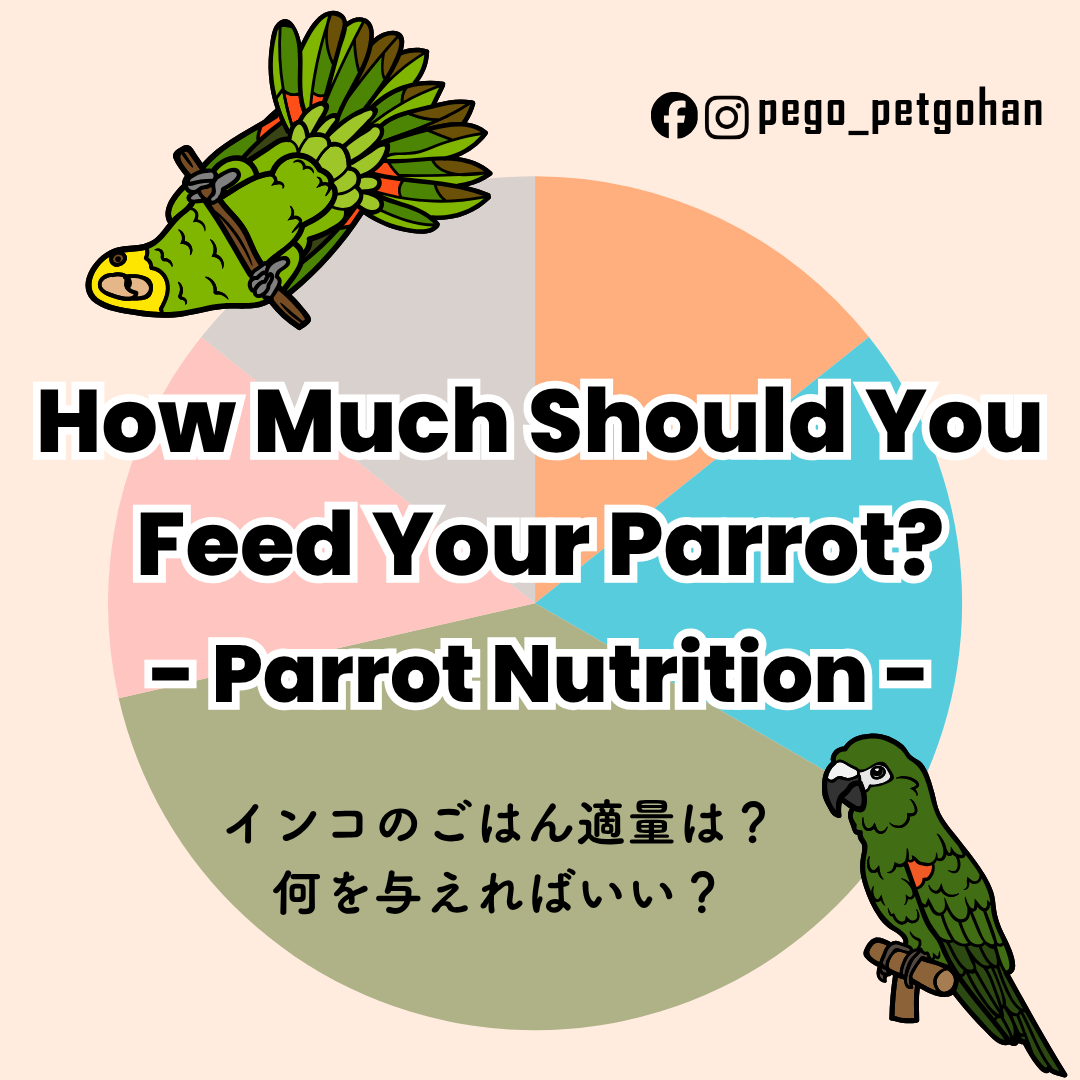
Parrot Diet Ratios (General Guideline)
A parrot’s diet is easier to balance when you combine foods like the following:

- Soaked foods: 10–15%
- Sprouted foods: 10–20%
- Fresh vegetables: 30–40%
- Fruit: 10–15%
- Dried foods: 10–15%
By combining multiple types of food like this, you can provide a wider range of nutrients.
As a general guideline, the recommended feeding amount below assumes that all the foods shown in the chart above are mixed together.


This style of feeding is what we refer to as the “Tablespoon method.”
First, offer the amount shown above and observe what your parrot eats and what they leave behind. This can help you better understand any selective eating habits.
If your parrot finishes everything, you can consider offering a little more while continuing to observe.
If some food remains, it is best to wait before adding more. This helps prevent your parrot from filling up only on their favorite foods.
When too much food is offered at once, the amount of preferred items also increases, making it easier for parrots to fill up by eating only what they like. Even with a well-balanced meal, offering too much at once can lead to selective eating.
To help avoid this, it is recommended to wait until the food is finished before offering more.
How to Think About Nutrition If You Are Concerned About Balance
Especially when feeding whole foods, many parrot owners worry about whether their parrot is getting proper nutrition every day.
However, it is not necessary to provide every nutrient perfectly every single day.
What matters is whether a wide variety of foods are included in a well-balanced way over time. By consistently incorporating diverse whole foods into your parrot’s daily meals, it becomes much easier to maintain a naturally balanced diet.
As one helpful approach, you can think about foods in color groups, as shown in the chart below.


How to Choose Foods Using the “3 Meals + α” Method
Planning daily meals becomes easier when you group foods as follows:
- Red Foods (such as carrots, purple cabbage, beets, berries, etc.)
- Green Foods (such as dark leafy greens, sprouted foods, etc.)
- Yellow Foods (such as pumpkin, yellow bell peppers, mango, pineapple, etc.)
- Other (such as herbs, seeds, nuts, insects, etc.)
For your parrot’s daily meals, selecting 1–3 items from each color group and combining them can help prevent nutritional imbalance. By gradually increasing the variety over time, both you and your parrot can become more comfortable with a colorful and diverse diet.
Soaked Foods
These are seeds or legumes that have been soaked in water.
They become softer than in their dry state, which can make them easier to eat.
Examples
- Buckwheat
- Fenugreek
- Lentils
- Millet
- Pumpkin seeds
- Quinoa
- Sesame seeds
- Shelled nuts
- Split peas
- Sunflower seeds
- Triticale
If soaked for too long, the food can spoil easily, so it is important to use an appropriate soaking time.
Instructions are here.
A soaking time chart by seed type is here.
Sprouted Foods & Microgreens
These are foods made by sprouting seeds or legumes.
It is known that the nutritional state changes during sprouting, and in particular, enzymes increase, making them highly nutritious.

Examples
- Adzuki beans
- Alfalfa
- Amaranth
- Arugula
- Broccoli
- Cabbage
- Chia seeds
- Garbanzo beans
- Kale
- Kohlrabi
- Lentils
- Mung beans
- Mustard
- Purple cabbage
- Radish
- Various microgreens
Sprouted foods are one of the foods many parrots enjoy, and they can also be used to add more variety to the diet.
The benefits of sprouted foods and how to make them are available here.
A soaking time chart by seed type is available here.
Fresh Vegetables
Vegetables make up the largest portion of a parrot’s diet.


Examples
↑ Please refer to the image above.
- Finely chopped
- Cut into large pieces
- Skewered
- Use a different dish than usual
- Try changing the feeding location
Even small changes in how you offer food can provide enrichment.
It would be wonderful to prepare a wide variety of foods every day, but not everyone is able to do that.
A recommended approach is to start by offering just one type of vegetable each day, and then gradually increase the variety over time. Since parrots have long lifespans, it is perfectly fine to take your time—ideally expanding their diet over months or even years.
If you are not sure which vegetables are safe to feed, please check here for a list of foods that are safe for parrots. Some of the foods on that list may be ones you have heard are “not safe for parrots.” If so, we encourage you to research for yourself why they are considered unsafe.
Fresh fruit
Fruit is beneficial not only nutritionally but also for enrichment. Consider including fruit in appropriate amounts as part of every parrot’s diet. In the past, some people believed that fruit should not be fed to parrots because of its sugar content, but today this is considered outdated information.
In Japan, for example, we have even received feedback suggesting that the amount of grapes given to small parrots should be as little as a single ear pick scoop—an extremely tiny amount, roughly just a pinch. When fed in appropriate amounts, fruit does not negatively affect a parrot’s health.


Examples
↑ Please refer to the image above.
If you are concerned about sugar, we recommend offering slightly underripe fruit. Compared to fully ripe fruit, it contains less sugar.
Dried Foods


Examples
- Freeze-dried foods
- Dried fruit
- Dried grains
- Dried herbs
- Dried roots and leaves
- Dried vegetables
- Seeds
Dried foods can be offered as part of the diet, but they can also be used as materials for foraging. When feeding them as part of a meal, lightly misting them with water to add moisture can help make them easier to digest.
Raw nuts
Nuts are sometimes avoided because they are high in fat, but fat is an important nutrient for parrots. Parrots have a high resting metabolic rate, meaning their metabolism remains high even when they are calm and inactive, so for all parrot species, it is important to consume essential fatty acids in appropriate amounts (except for nectar-feeding species).
Many nuts contain omega-3 fatty acids, which are often lacking in pellet-based diets. We especially recommend offering nuts to parrots that rely on pellets as their main diet and to parrots during molt.


Examples
- Almonds
- Brazil nuts
- Cashews
- Hazelnuts
- Macadamia nuts
- Pecans
- Pistachios
- Walnuts
Not recommended
- Peanuts
- Heated nuts
Please never feed peanuts.
Although they are commonly called “nuts,” peanuts are actually legumes, and raw legumes should not be fed to parrots. Peanuts are not recommended for parrots due to the potential risk of aflatoxin and their less favorable fatty acid profile.
Since many safer and more suitable nuts are available, there is no need to include peanuts in their diet. When offering nuts, they should be provided in their raw, unheated form rather than roasted or toasted varieties.

 ↑ This photo was shared with permission from @vanilla_crow (a parrot owner in Japan). There are many meal posts on Instagram, so feel free to take a look if you are interested!
↑ この写真は、@vanilla_crow (日本のインコ飼いさん)の画像をお借りしました。Instagramには食事に関する投稿がたくさんありますので、良かったらチェックしてみてください!
Final Thoughts & References.
Thank you very much for reading to the end. This blog is published in multiple languages using translation tools, so we apologize if any part sounds unnatural.
Everyone has different beliefs and ideas about what is best, and we do not expect everyone to agree with everything in this blog. We simply hope it may offer a helpful perspective. If anything is unclear, we encourage readers to take the time to look into it further using reliable, well-supported information.
In this blog, we primarily draw on information learned from Dr. Jason Crean, along with the following sources. All of them provide clear and trustworthy insights. This is not an exhaustive list, and we continue to learn from many other sources as well.
This article is intended as a simple introduction due to its length.
We plan to cover these foods and feeding approaches in more detail in future blog posts!
Biodiversity Bird Blends
Best Behaved Birds
Parrot Stars
World Parrot Trust
Dr. Karen Becker