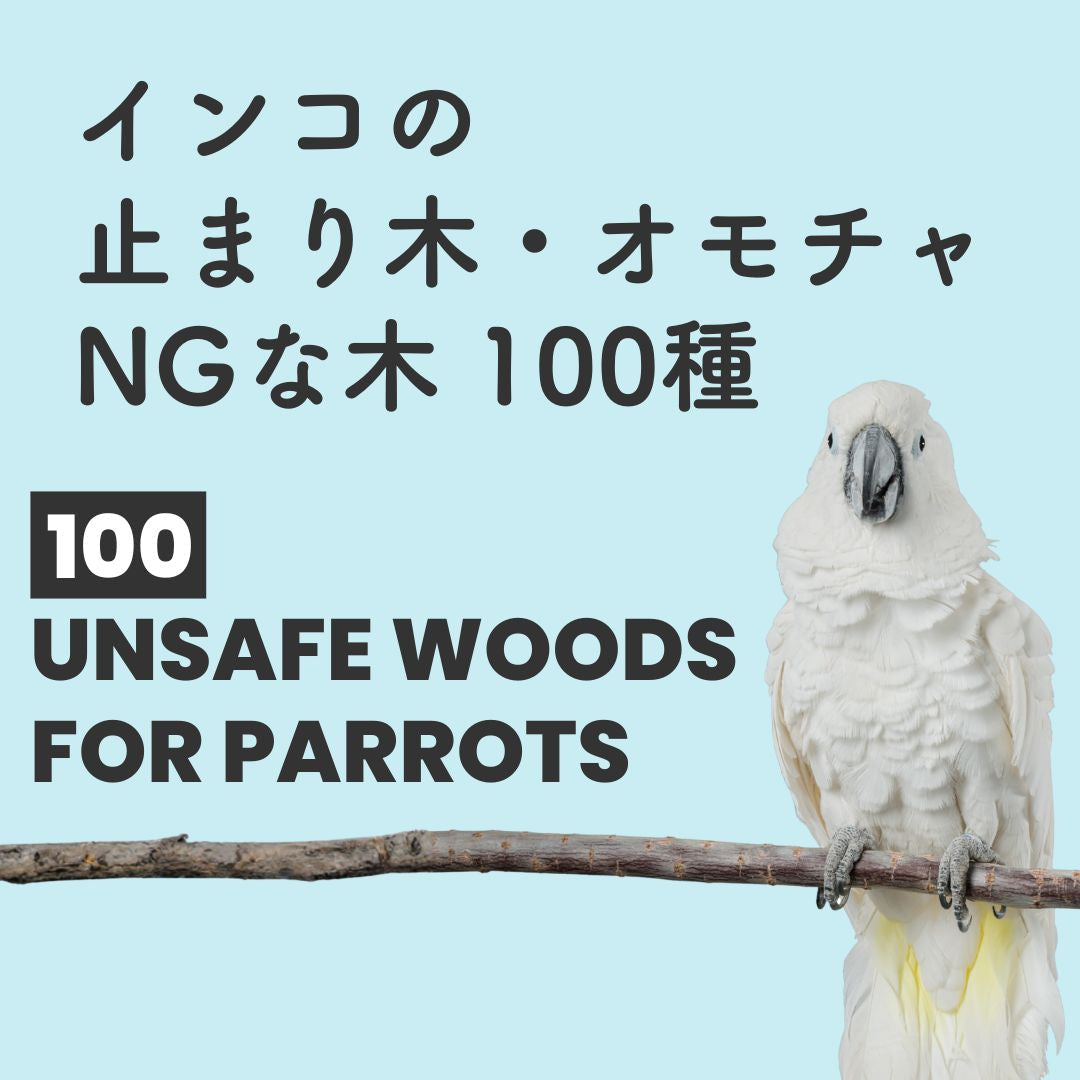
インコやオウムの止まり木やオモチャの木は、鳥の健康や安全に大きく関わります。
しかし、すべての木が鳥に安全とは限りません。木の種類によっては有毒成分や刺激物質を含むものもあり、誤って使用すると健康リスクにつながる可能性があります。
インコに安全ではない止まり木やオモチャの木の種類についてリストを作成しました。
このリストの内容は、アメリカの樹木医(Arborist)であるMario D. Vaden が作成し、アメリカの獣医師がチェックしインコに安全ではないと判断した内容のリストです。それを許可を得て翻訳して掲載しています。
和名が全て適切ではない可能性があります。英語名の原文が最も正確ですので、必ず英語名でもご確認ください。
4月12日更新:当店は樹木に関する専門的な知識は有しておりませんし、ただの和訳記事だということも最初から明記していました。そのため、木に関するお問い合わせにはお答えできない旨を最初から記載し、ご不明点については専門家へご自身でご確認いただくよう予めご案内しておりました。安全ではない理由についても、当初からハッキリと原文を掲載しておりました。
しかしながら、2026年3月に当ブログの内容について、掲載している各木の毒性成分において明確な理由と、インコへの影響をしっかり調べて掲載するようになど、著作者(樹木の専門家)以上の専門性の高いご要望が日本からありました。
これにより、一部のXでは混乱を招いてしまい、これ以上の混乱を防ぐため、当ブログにおける日本語での追加情報の更新(安全ではない理由の正確な和訳修正、安全な木の種類リスト、農薬に関する注意事項など)を中止することといたしました。
当時のブログはコチラ
-----
この記事は全言語(日本語は一部)翻訳ツールを使用して多言語で生成されています。不自然な箇所は予めご了承ください。内容はAI情報ではありません。きちんと実在する専門家の情報を翻訳しています。
Bad wood/インコに有害な木
| ALDER - Red alder |
ハンノキ(レッドアルダー)
|
| ANDROMEDA -Pieris, Lily of the Valley shrub |
アンドロメダ - ピエリス、スズランの低木
|
| APRICOT | アンズ |
| ARROWHEAD VINE | シンゴニウム |
| AUSTRALIAN FLAME TREE |
ブラキキトン(オーストラリアンフレームツリー)
|
| AUSTRALIAN UMBRELLA TREE |
シェフレラ(オーストラリアンアンブレラツリー)
|
| AVACADO | アボカド |
| AZALEA - Related to Rhododendron |
ツツジ - シャクナゲ関連
|
| BANEBERRY - Actaea |
ルイヨウショウマ属
|
| BEANS -castor, horse, fava, broad, glory, scarlet runner |
豆類 - トウゴマ、ソラマメ(horse / fava / broad)、グローリービーン、ベニバナインゲン
|
| BLACK LOCUST - Robinia | ニセアカシア |
| BOX ELDER |
トネリコバノカエデ
|
| BOXWOOD - Buxus | ツゲ(黄楊) |
| BUCKTHORN - Cascara / Alder Buckthorn |
クロウメモドキ属
|
| BRACKEN FERN | ワラビ(蕨) |
| BURDOCK | ゴボウ |
| CACAO | カカオ |
| CAMEL BUSH - Trichodesma |
キャメルブッシュ - トリコデスマ属
|
| CANARY BIRD BUSH - Crotalaria |
カナリーバードブッシュ - クロタラリア属
|
| CANNABIS | アサ(麻) |
| CASTOR BEAN |
トウゴマ(唐胡麻)
|
| CEDAR - Thuja, Chamaecyparis, Cupressus |
シダー - クロベ属、ヒノキ属、イトスギ属
|
| CHALICE - trumpet vine |
チャリス - ノウゼンカズラ(凌霄花)
|
| CHERRY | サクラ属 |
| CHINA BERRY TREE - Melia / Texas umbrella tree |
センダン(栴檀) - メリア / テキサスアンブレラツリー
|
| CHINESE MAGNOLIA - uncertain for safety |
モクレン類(シナモクレン系、安全性不明)
|
| CHINESE POPCORN / TALLOW |
ナンキンハゼ(南京櫨)
|
| CHINESE SNAKE TREE - Laquer plant | ウルシ(漆) |
| COMMON SAGE | セージ |
| CORIANDER - Cilantro |
コリアンダー(香菜)
|
| DATURA |
チョウセンアサガオ(朝鮮朝顔)
|
| DAPHNE - it's the berries |
ジンチョウゲ(沈丁花) - 有毒なのは果実
|
| DATURA STRAMONIUM - Brugmansia - angel's trumpet |
チョウセンアサガオ(朝鮮朝顔)/ブルグマンシア(エンジェルストランペット)
|
| DIEFFENBACHIA |
ディフェンバキア
|
| ELDERBERRY |
ニワトコ(接骨木)
|
| EUONYMUS - Includes burning bush and more |
ニシキギ属(錦木属)
|
| EUPHORBIA |
トウダイグサ属(灯台草属)
|
| FELT PLANT - Kalancho baharensis |
カランコエ・ベハレンシス
|
| FLAME TREE | カエンボク |
| FIRETHORN - Pyracantha | トキワサンザシ |
| FLAME TREE - Brachychiton / Sterculia |
ブラキキトン属/ステルクリア属
|
| FOXGLOVE - Digitalis (pharmaceutical source) | ジギタリス |
| GOLDEN CHAIN TREE - Laburnum | キングサリ |
| GROUND CHERRY | ホオズキ属 |
| CROWN OF THORNS | ハナキリン |
| HEATHS |
ヒース(エリカ属)
|
| HEMLOCK - Tsuga | ツガ(栂) |
| HOLLY - Ilex | モチノキ属 |
| HONEY LOCUST - Gleditsia | サイカチ属 |
| HORSE CHESTNUT - Aesculus | トチノキ属 |
| HUCKLEBERRY - leaves bad: evergreen & deciduous | スノキ属 |
| HYDRANGEA | アジサイ属 |
| JASMINE |
ジャスミン(ソケイ属)
|
| JUNIPER - Juniperus |
ジュニパー(ビャクシン属)
|
| KALMIA: also called Mountain Laurel | カルミア属/マウンテンローレル |
| KENTUCKY COFFEE TREE | ケンタッキーコーヒーツリー |
| LANTANA - red sage |
ランタナ(シチヘンゲ) - レッドセージ
|
| LAUREL - Prunus |
ローレル(サクラ属)
|
| LEUCOTHOE | ルコトエ |
| LUPINE | ルピナス |
| MANGO - (fruit okay: not wood or leaves) |
マンゴー(果実は可:木や葉は不可)
|
| MEXICAN BREADFRUIT |
ラモンノキ(ラムノキ)
|
| MOCK ORANGE - Philadelphus | バイカウツギ属 |
| MONSTERA - big hunker of a house plant | モンステラ |
| MOUNTAIN LAUREL - Kalmia latifolia |
マウンテンローレル/カルミア
|
| MYRTLE - broadleaf evergreen, not crape myrtle | ギンバイカ |
| NECTARINE | ネクタリン |
| NUTMEG | ナツメグ(ニクズク) |
| OAK - Quercus - all parts / tannins |
ナラ属(ミズナラ、コナラ、カシ類など全体にタンニンを含む)
|
| MISTLETOE | ヤドリギ |
| OLEANDER | キョウチクトウ |
| PEACH | 桃 |
| PEAR - some sources lean toward safe |
梨(安全とする資料もある)
|
| PENCILTREE | ミルクブッシュ |
| PITCH PINE | ピッチパイン |
| PLUM | スモモ(李) |
| PRARIE OAK - safety uncertain |
プレーリーオーク(安全性不明)
|
| PRIVET | イボタノキ |
| RAIN TREE |
レインツリー(アメリカネムノキ)
|
| RED MAPLE |
アメリカハナノキ(アメリカカエデ)
|
| RED SAGE - Lantana |
ランタナ(シチヘンゲ) - レッドセージ
|
| REDWOOD - Sequiadendron, Metasequoia, Sequoia |
レッドウッド類(セコイアデンドロン属・メタセコイア属・セコイア属)
|
| RHODODENDRON |
シャクナゲ属(石楠花属)
|
| RHUBARB | ルバーブ |
| SAND BOX TREE - sap was used to poison fish |
サンドボックスツリー
|
| SKIMMIA - entire plant: stem, berry, leaves |
ミヤマシキミ属(植物全体:茎・果実・葉)
|
| SOLANUM - Jerusalem cherry or pepino |
ナス属 - フユサンゴ / ペピーノ
|
| SOPHORA - includes Japanese pagoda tree |
ソフォラ属 - エンジュを含む
|
| SUMAC - not all sumacs are bad |
ウルシ属(漆属) - すべてのウルシ属が有害というわけではない
|
| TOBACCO | タバコ |
| TANSY |
タンジー(ヨモギギク)
|
| TOMATO | トマト |
| UMBRELLA TREE |
シェフレラ(ホンコンカポック)
|
| WALNUT | クルミ |
| WEEPING FIG - Ficus benjamina > Ficus elastica safe |
ベンジャミン(シダレガジュマル) - フィカス・エラスティカは安全
|
| WHITE CEDAR - China | ホワイトシダー |
| WITCH HAZEL - Hamamelis |
ウィッチヘーゼル/マンサク
|
| WISTERIA | フジ(藤) |
| YEW - Taxus |
イチイ属
|
インコに安全な食材リストはコチラ

【ペゴが調べた有害な木】
Camphor tree/クスノキ:化学的に毒性成分を含む植物なので木は安全ではないとされている。果実はセーフ。
備長炭:日本では人気の備長炭パーチですが、鳥類生物学者に確認したところ、どの鳥種にも与えるべきではないとのことです。(そもそも備長炭をインコに与えているのは日本だけのようです)
OAK(オーク):以前に何度か質問されたことがあります。
当店は木の種類に詳しくないのですが、この記事を参考にお答えしますと、学名にQuercus(コナラ属)と付いているものは鳥に安全ではないので使用しないほうがいいです。OAKは約400種以上もあるらしいので全種類の安全性については不明です。
【正確性について】
このリストの内容が必ずしも100%正確な情報というわけではありませんが、木のプロフェッショナルが作成したリストなので一般的に出回っているネット情報よりは信憑性があるリストだと思います。
ですが、インコ・オウムに安全な木の種類の研究はありません。食材と同じで、鳥種によって安全性は異なることがあります。このリストは、一般的に「木に存在する毒性」を見て鳥に安全ではないと判断されたリストなので、飼い主もよく調べてからお使いください。
【安全な木のリストについて】
4月12日更新:当ブログにおける、以下の追加情報の日本語での更新は中止いたしました。
- 安全な木の種類リスト 85種
- 安全ではない理由のより正確な和訳への修正
- 農薬に関する注意事項など
※他の記事同様、当記事の無断使用・無断転載はご遠慮ください。
Mario D. Vadenとは
このリストを作成したMario D. Vadenとは、インコを飼育しているアメリカのArborist(樹木医 / 樹木管理専門家)であり、Tree Risk Assessment Specialist(樹木リスク評価専門家)としても知られています。樹木の安全管理や樹上作業の教育を行う樹木の専門家です。長年にわたり樹木管理やツリークライミングの分野で活動しており、樹木の健康管理、危険木の評価、伐採や剪定技術の指導などを行っています。樹木の安全性、木材の利用、樹上作業技術などに関する専門家です。
リストに無い種類のご質問について
以下は Mario D. Vaden からのコメントです。
「このリストに掲載されていない木について、『この木は鳥に安全ですか?』という問い合わせのメールをよくいただきます。しかし、このリストは私たちが現在把握している情報をまとめたものです。一般的に使われている木の名前を意図的に掲載していないわけではありません。このリストに書かれている内容が、現時点で私たちが知っているすべての情報です。もし、安全な木について信頼できる情報源とともに提案していただける場合は、新しい情報として更新します。私たちは常に新しい情報に対してオープンです。」
つまり、リストに掲載していない木の種類については一切回答できないということです。
またペゴも食事・栄養の専門店ですので、木に関する知識はありません。お問い合わせにはお答えできかねますので、ご不明点は日本の樹木医や生物学者、専門知識を持って止まり木やオモチャを扱っている作家などにお問い合わせください。(※獣医師は治療の専門家、バードトレーナーは行動学の専門家なので植物の専門家ではありませんのでご注意ください)
「この木は安全です、NGリストに入れないでください」というご意見は先述している通りMario D. Vaden宛に信頼できる情報源を直接、提示してください(連絡先をお伝えします)。Mario D. Vadenが訂正した場合、当店もリストを訂正いたします。この記事はMario D. Vadenに許可を得て翻訳しているだけですので、当店の判断で勝手にリストを変更することはできかねます。
上記リストのNGな理由
2026年4月12日更新:文章量が多く、説明(和訳)も難しかったため当初は英語版のみですが、NGな理由の原文を記載しておりました。しっかり時間をかけて日本人が分かりやすいように正確に和訳する予定でしたが、当ブログの更新を中止したため、「なぜ上記リストが鳥に安全ではないのかに関する理由」の和訳も中止しました。当初に英語ページで公開してたものと同じ、原文を掲載します。
ここに記載している以上の内容を知りたい場合は、ご自身で専門機関に依頼したり専門家に相談して判断してください。以下、原文です。
Ailanthus altissima / Tree-of-Heaven, China Sumac Also called the Ghetto Palm. The following was posted on the Perdue University website about, and seemed worth sharing the comment: Source: James A. Duke. 1983. Handbook of Energy Crops. unpublished.
"Leaves are toxic to domestic animals (Perry, 1980). Gardeners who fell the tree may suffer rashes. Mitchell and Rook's observations are more violent than my own to sniffing the leaves, "The odour of the foliage is intensely disagreeable and can cause headache and nausea...rhinitis and conjunctivitis...The pollen can cause hay fever." (Mitchell and Rook, 1979)."
This caught my attention when this species became a topic of discussion on a arboricultural forum. The article just points out leaf toxicity. And for the present, I will leave it in the wood safe column. The is a fairly lengthy Wikipedia Topic for this species. The potential for rash appears anecdotal. One Canadian government information system site wrote " However, convincing documentation ... lacking". Little seems more than "may have"
Fertilizer Someone emailed about whether fruit wood is safe after fertilizing. My 1st question was if they still had the package. Most fertilizers supply elements that are found in soil anyway, like iron or nitrogen. Whether fertilizer is sythetic or organic, it's purpose is to supply one or more of just 17 Essential elements. And if that's all that was applied, the wood should be fine for perches. But some fertilizers may have fungicides or insecticides added: systemic ones. That's why you would need to read the entire package to make sure that it was basic fertilizer for nutrition purposes only. Also, you might want to avoid branches where fertilizer was applied foliar from above: like sprayed on. But if plain fertilizer was added to soil only, the wood should be okay.
Lumber wood information Pressure injected wood: don’t use it for birds: perches, toys or structures. Also, if you find lumber, do you know what contacted it? It's like an unbroken chain of possession for evidence. If you left lumber in a shed that several people use and haven’t been there for a year, how do you know what may have spilled? What kind of dust settled? Most light pine lumber in stores is not coated with anything. But ask anyway. Pre-cut stakes, such as those used for surveying, may have been coated due to the need to remain in the ground. We can’t be certain 100% of the time, but every piece of information brings us nearer 100% accuracy. A square edge perch is not a good. You could remove square edges, and round wood is better. Natural branches are the best because the diameter differs from small to large, allowing birds feet to stretch and contract.
african grey parrot on perch
Aromatic Substances Refer to other bird sites for aromatic info. But I'm leaving this comment about Teflon. Switch from Teflon pans to something like stainless steel or cast iron. Teflon pans over-heating, can emit substances deadly to birds. We try to keep perfume, aromatic scents and colognes to an absolute minimum at our home.
Check Plant Names For our lists, or others, check common names to know the genus, scientific name and common name. For example, Douglas fir is not a fir. Western cedar is not a cedar.
Balsa Wood This is our birds favorite to play with. Most sources indicate that balsa is safe for birds. I contacted avian veterinarians in Oregon and California, and got the same feedback - that balsa wood is fine. You won’t want balsa for a perch. A cockatiel can chew through balsa in minutes.
Cleaning Wood One philosophy says clean bird perch wood before it’s used by soaking for an hour or two in tub of water with a cap of household bleach. Then rinse the wood in clean water. Another says Chlorine bleach may cause an occasional sickness or fatality. Maybe due to too strong of a solution. The second philosophy may use mild soap and water solution followed by rinsing with clean water. Both viewpoints agree about allowing wood to dry thoroughly, including exposed to direct sunlight. Oven drying needs to be hot enough to kill microbes, but cool enough to avoid combustion.
Alder is not Alder Buckthorn - The 2 alders One person emailed a concern about a substance Cascara sagrada acting as laxative. Its made from bark of Buckthorn with a common name Alder Buckthorn. Its not an Alder or Alnus. Buckthorn is Rhamnus purshiana. To my knowledge, Alnus has no Cascara sagrada. Red Alder On a USDA Forest Service Pacific NW lumber page, was a footnote for red alder "Toxicity: can cause dermatitis". Red alder is not the only alder we have in Oregon. There is also Alnus rhombifolia called white alder. A source about white alder for use by Ohlone Indians, said they used it for diarrhea. My conclusion: avoid Re Alder.
Note: January, 1, 2010, I read from Univ. of B.C. that Rhamnus purshiana is now called Frangula purshiana. Apparently something that has gone back and forth previously in the past couple of centuries.
Birch The following comments are a PARAPHRASE from Gillian Willis - author - with clarification:
Birch is Betula species. LEAVES & BARK contain salicylates and a few substances ... . The low concentration ... Birch should be considered safe for natural wood perches. The seeds inside the cones are a special goodie safe for birds to eat. (end of paraphrase) Think: Automobile fumes can be damaging. We don't want to be enclosed where the fumes are trapped. But walking down the street where those fumes are in the air at low concentrations, we feel safe to breath. As noted, Birch should be considered safe and the risk of leaving bark is inconsequential.
Cherry Some sources debate about cherry wood being bad to pet birds, for a lack of substantial confirmed cases - although confirmed cases of problems for a few dogs and horses is apparent. Some folks lean toward using cherry wood, but not the bark, under the premise that the chemicals are primarily in the cambium - layer under the bark. Do you know what that layer is? Do you see what I'm getting at here? When there are an abundance of sure safe woods, why use one that has bark with potential bad stuff in it? Suppose there are no confirmed cases of dead birds from cherry. If cherry turns out to be a subtle problem, would you want your bird to be the first confirmed case? I suspect there are cases not documented. There must be hundreds of birds dying each year due to real causes that we don't know about.
Driftwood Driftwood is not recommended for a few reasons: 1. There is no certainty for the average person about the tree genus. 2. The ocean water environment contains organisms not to mention every kind of animal waste in addition to residue from ships. It is an uncertain environment. 3. Driftwood can have high salt content. Imagine all the crud that embeds into that wood.
Ironwood Hop-Hornbeam called Ironwood and American Hornbeam, is added here to clarify what kind of email will make it to this page. I am after safe wood information and not so much leaf info. Someone shared a factual research link, showing that this Ostrya virginiana has cyanogenic glycosides in leaves, but nothing said about wood. (Science Direct article). Wild birds like the seeds. The hard wood is good for fence posts or tools. So people could choose it for perches. Without facts about wood, I can't say, and reduced the message to this paragraph. The note was in the ballpark of info worth sending; just shy of making the wood list above.
Larch or Dawn Redwood - Larch is in the safe wood list. In case you did not know it, Larch is a deciduous conifer. It looses it's needles in winter. The needles are attached in little clusters on pegs like little tufts. There is another tree Dawn Redwood which is also a deciduous conifer. It's needles are attached to the twigs individually and somewhat two-ranked on either side of the twig. Initially, new spring growth looks like little tufts, but these elongate into tiny mini-twigs lined with ranks of individual needles. Dawn Redwood is not on the list above. It's genus is Metasequoia (sp. glyptostroboides). Avoid using Dawn Redwood - feel free to use limbs from Larch (Larix).
Linden The Linden is such a common species, I was surprise it was not included when I started this page back in 2004. Somebody inquired about Linden for perches in 2018, and I replied, because their question was identification related with photos of seeds and leaves. After identifying it for them, they found some information. Here is what they wrote in a followup email:
"I did some research and found the following links. This website lists Linden as not having any toxic affects on animals: https://vcahospitals.com/know-your-pet/plants-safe-for-birds . This next website says that wild birds will consume the buds and leaves, but also notes that so far there has not been any documentation of the affects they would have on domesticated birds: http://africangreyparrot.info/thread/3588 ... This last link has links to some websites that have listed it as safe http://forums.avianavenue.com/index.php?threads/basswood-safe.8662 ... Hopefully these can help. (Mileidy C.)"
Maple Originally, this page only listed two maple trees: vine maple as safe, and red maple as potentially harmful. I've included "maple" in the safe list now, but with this condition: remove the bark. It may not be absolutely neccessary, but its the only way that I'll suggest most of that tree genus. From what I've read, the bark of many maple trees, like vine maple or Japanese maple, etc., is fine. Meaning, the bark in itself is not deemed a problem. But red maple (Acer rubrum) can harbor a fungus. Inhalation of exuded residue may be harmful. Maple wood - in general - should be safe for natural wood bird perches once bark is removed. One source wrote that "red maple" is bad for horses, not really specifying why. Currently, I'd use almost any maple branch for a bird toy or perch..
Note about an Acer (Maple) called Boxelder. I do not know the reason sources I found have "maple" mostly as safe wood and "Boxelder" as unsafe. Boxelder does look unusual to most people as a maple because the leaf shape is very different from the stereotypical maple leaf shape. So maybe there's more different than just the way the leaves look. And hardly anybody calls it "maple", even in the landscape trade. So treat Boxelder as if it were not maple pertaining to the bird and wood thing.
Mulberrry / Morus (report) In September 2012, I got an email related to Mulberry. The person said their vet ID'd the plant. No specific species given, or ID photos to prove how the vet concluded identification. Below, are parts of the email ...
"just had a pair of scarlet-chested parrots at the vet for two nights due to mulberry branches having a diuretic effect and causing severe diarrhea and weight loss. It would be worth noting then that they are not safe for all species and use of mulberry leaves should be avoided with the neophema group. " And ... [quote] "I work in a pet shop and leaves from the same tree were given to birds there as well, and again it was only the scarlet chested parrots that had anynoticeable reactions."
The note specified "leaves", but I clearly open this page in the first sentences that my lists assume branches are free of leaves and fruit. Thought the message may be of interest anyway.
Pine We read an article about Pine and Cedar containing compounds that can cause lung or sinus problems. But the article was about bedding like shavings put in bottoms of animal cages; more common for hampsters and other pets; rarely for parrots or cockatiels. When we listed pine above, that meant as perch wood which this page is primarly intended for.
Pine is one of the species I would be less likely to use due to the type of sticky pitch that often oozes from it or beads-up on the bark. If I used branches, I would most likely let the wood age for 4 to 8 months, not just a matter of days, so any pitch would manifest itself.
But we have used pine wood from the hardware store often to build little boxes and stuff. I select the wood for boards without signs of pitch or sticky surfaces. Then I let it sit for months to see if the wood's inside bleeds any pitch spots or areas.
Pitch in the pine will be an awful thing for bird feathers. And although I have not asked any vets yet, I suspect some pitch can be sticky enough to hold a beak together unless its cleaned. Don't know for certain, but wouldn't surprise me.
The preponderance of sources I find indicate that pine cones are okay for parrots, etc., but those have to be checked for pitch spots too. Sites that recommend cones say to heat them in the oven for a while, and to select ones that have not been laying around too long on the ground, like sitting all winter or with moss. Since they can burn, watch your temp and time carefully.
Photinia In May 2010, someone told me that Photonia leaves have Arsenic in them, and was toxic to horses. The only reference I could find online was a New Zealand Alpaca site with a table listing Photinia leaves as toxic with Arsenic. But no other references. Then I found a website of a Manes and Tails Organization, which included excerpts from The Merck Veterinarian Manual: Poisonous Range Plants of Temperate North America. The notes stated: Cyanogenic glycosides in foliage and fruits, hydrolyzed in GI tract to free cyanide, thereby affecting cellular respiration.
Keep in mind that the reference was about foliage on a grazing animal website. and that my page here deals with woods or branches expected to be free of leaves, fruit or flowers. Just the branches. So I still believe that Photinia wood is fine for bird perches. I was still glad to find the information though.
Sumac - Rhus One sumac on this page is Staghorn Sumac - a safe tree. And the genus is Rhus. Its fruit berries have been clean washed and made into a good lemonade when sweetened. Native American Indians even mixed its leaves and fruit with tobacco for smoking. A broad range of plants may be called sumac, some safe, some not. Some species in the genus Rhus are potent and can also cause severe skin irritation to some people. Other species like Rhus typhina are not bad. Most naught species have axillary panicles and smooth fruits. The okay species have upright, dense, conical drupe type fruits, covered with crimson hairs.
Walnut - quote from an email sent from Pennsylvania
Start Quote "Here is my personal experience with black walnut trees in Pennsylvania. I got my two birds (Goffin's Cockatoo & Sun conure) in November 1996. In April 1997 I bought a house for us. My avian vet said black walnut was OK to use for perches, but to let it dry first. Over the years, squirrels have filled my yard with these trees. Since summer 1997 I have used black walnut branches & tree trunks, fresh-cut and green, with leaflets attached, as perches. My birds love to destroy the foliage, and then chew the bark off. Black Walnut and Manzanita are the only woods I have used for perches in all this time. (Note: no pesticides, fertilizers or any other chemicals are used in my yard.) They also love the walnuts that I crack with a brick. We recently had a "good" health check - my conure is now 18 and sadly, starting to get a bit cranky. We have had no adverse effects from 17 years of chewing on fresh black walnut wood"End Quote
My thoughts ...
The email had the senders name, and did not name which avian vet, but I believe the message is a real experience. First thing ... my page is devoted to birds as a whole, not just one person's birds. And whereas this person's parrots destroyed and chewed leaves, it does not say they ate them. Maybe other birds would eat the leaves or a little bark. The note relays that the vet said Black Walnut was okay for perches ... nothing about playtoy aspects of leaves or bark, nor other kinds of Walnut. If their avian vet is up to speed on recent knowledge, this would leave me more confident in at least one kind of Walnut. Except ... with so many other species having a more solid reputation, I would probably try and use another kind of wood. If I did use Walnut, all the leaves, bark and acorns would be completely removed ... FWIW ... note that the avian vet said to dry the wood first, but the person apparently went beyond that professional advice. Not sure whether it was based on extra advice not mentioned, or merely personal choice.
Apparently Walnut has much less tannins in wood than leaves or acorns, so that may be why the avian vet went with the recommedation.
Willow Someone sent me a URL for a University of Maryland University medical center page about some willows, and and how the bark contains salicin: similar to aspirin (acetylsalicylic acid). Apparently the wood does not contain the compound like the bark does. One excerpt reads:
"The willow family includes a number of different species ... ... Some of the more commonly known are white willow/European willow (Salix alba), black willow/pussy willow (Salix nigra), crack willow (Salix fragilis), purple willow (Salix purpurea), and weeping willow (Salix babylonica). The willow bark sold in Europe and the United States usually includes a combination of the bark from white, purple, and crack willows"
The article sounds reliable, and apparently the bark and compounds are effective for human use it they are not allergic to it. Based on that information, I would still be very inclined to use willow wood for parrot perches or bird stands. But would remove the bark. And if the branch is freshly cut, will be among the easiest to remove. I used this for hiking sticks, and in the spring, bark virtually peels off by hand. If its dry, just use a knife.
VINYL FLOORING CAUTION
conure parrot cage stand
Few things are added to this page beside wood and branches. But we experienced a problem with new vinyl flooring that seemed worth sharing. We decided to give them an entire small bedroom downstairs for an aviary. And laid about 10' x 11' of brand new vinyl flooring. No adhesives used. In the afternoon, we put the birds in the room for a couple of hours to get used to the space. I went down to check on them, and the male Green Cheek Conure was having trouble breathing and was leaning back hard on a branch. The female was in the cage also having problems breathing. I immediately took them upstairs. Anyway, in about 1/2 hour, they were in very good shape, back to themselves again. My best estimate, is that another 30 minutes in the room, would have been the end of at least one bird. We knew the stuff a smell to it, but never realized that it was hazardous to them. Just thought of it a a new product smell. I could not find anything online either.
Some of you may be aware of this issue from experience or something your read. For those who are not aware, there you are. The smell was mostly gone in a few days. At that point, we took the birds down for like an hour per day, for several days. About 1 week later was the first full day. But we had them sleep upstairs in a second cage for the 8th and 9th nights. It was about the 10th night we let them sleep in their cage in the new aviary room. Always leaving the door open too: all day. I built a 30" tall barricade to put in front of the door so they can't walk out. The wings are clipped. We try our best. And in this situation, I think "the Man upstairs" somehow got us to intervene in time.
おすすめ
小型インコにオススメのシードです。
シード、穀物、雑穀、ナッツ、野菜、果物、ハーブ、スパイス、花、葉、根など多種類の自然素材をバランスよくブレンドしたミックスです。小型インコが食べやすいサイズの食材を使用し栄養面でも計算されています。

中型インコにはコチラがオススメです。
穀物・シードに加え、ナッツ、ドライフルーツ、野菜、ハーブ、花などをバランス良く含んだシードブレンドです。食事内容の固定化を避けたい/食べながらフォレイジングさせたいというお悩みの方にオススメです。

添加物を一切使用していないホールフードサプリメントパウダーも人気です。シード食やペレット食など栄養が偏り気味のインコにオススメです。(欧米ではペレット食による栄養失調の報告が増えています)

米国の鳥獣医による毛引きセミナーも好評です。毛引きに悩む飼い主は勿論、毛引き以外の飼育情報の解説もあるので幅広い知識を身に付けられます。画像をタップすると目次が見れます。